(If you have not read the prologue, start here)
Throughout this trip, I was always taking photographs. Even when I climbed a 2,600-meter mountain by bike, I carried a camera that weighed nearly a kilogram, and in the end I took about 6,000 pictures. And still, there was so much of France that never made it into them. Some things I simply could not photograph. Others I thought I had captured, only to look back later and find that something essential had slipped away.
It happened on my very first night in France. Above the old town of Amboise stretched a vast sky. The long June day was finally beginning to fade, and clear, low light came pouring sideways through the air. The dramatic contrast between the darkness on the ground and the evening sun on the walls of the buildings felt astonishingly beautiful. I had driven the long way from Paris with my nerves taut the whole time, and perhaps that had something to do with it. But the scene would not enter the photograph.
Sometimes a scene unfolding slowly before my eyes was impossible to catch. Other times, a moment was so vivid and immediate that the camera simply could not get there in time.
Once, I was walking with a friend through Toulouse when a stylish older woman on a bicycle passed us. Her outfit revolved around a red dress, and everything from her hat to her shoes was coordinated in red. Apparently she had taken offense at a truck that had passed her, and she was now delivering a stream of curses toward the driver. I do not understand French, but the tone and gestures made it perfectly clear. There she was, on a Sunday, dressed sharply in her going-out clothes, riding her bicycle at an easy pace, and calmly telling off a truck many times larger than herself. That force of life, or maybe that complete fearlessness, made me smile. Precisely because there is no photograph, her voice, movement, and red clothes still remain fused together in my memory.
When I rode along country roads, every now and then I would pass an entrance that caught at me. Beyond the gate, a lane might slip quietly into the shade of the trees, leaving me unable to see what waited farther in. Someone’s house, belonging to someone I would never know, gently guarding an entire life I could only imagine. Later, when I looked at the photograph, that secret narrative had evaporated. All that remained was some unplaceable gate and a great tree.
Photography is, of course, a way of leaving something behind. But it is also a kind of medicine that keeps me sensitive to the beauty that makes my heart tremble. I stop, raise the camera, think about how to compose the frame, and press the shutter. On a bicycle trip, where I am always tempted to hurry onward, it gives me perhaps thirty seconds to slow down and face something beautiful. It is medicine for nudging myself into that posture.
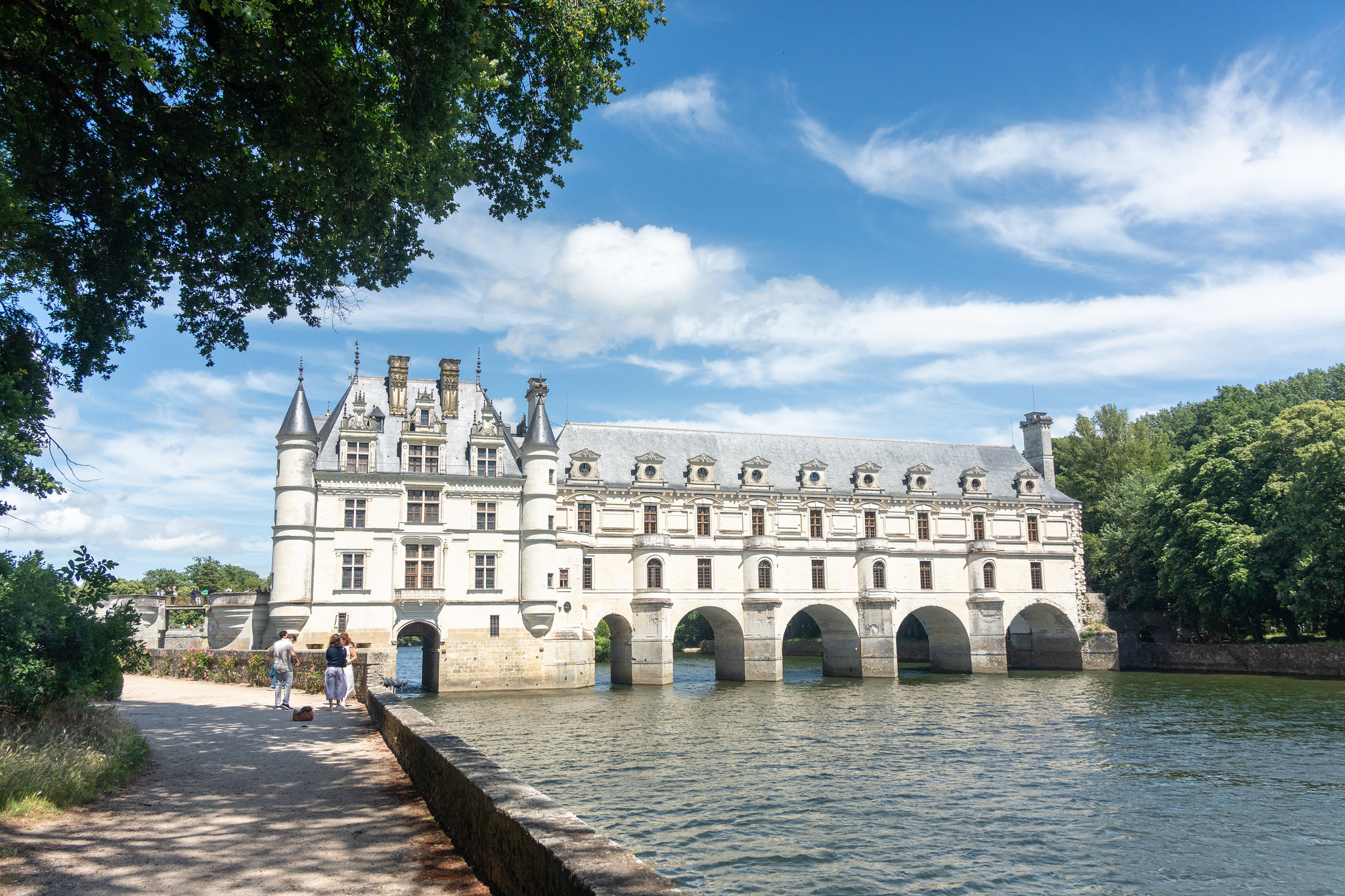
At times, thirty seconds did not feel nearly long enough to face beauty properly. There was a beautiful old château, Chenonceau, built across a river. Its pale limestone walls gleamed against the blue sky. The ornamentation was perfectly judged, never too little, never too much. There were great towers. Through the windows, the river flowed broadly into view, and the building had been designed so that sunlight and light reflected off the water entered through the windows and brightened the rooms within. Seen from the garden on the riverbank, roses filled the foreground and gave the château yet another layer of grace. It was the kind of lovely, delicate castle that made me want to paint it in transparent, pale watercolor.
I had heard it was beautiful, so I arrived with a certain amount of expectation. But once the real thing stood before me, all that came out was something between a sigh and a laugh. Perhaps it stands at one of the peaks of the kind of beauty that people in France have polished over generations. Even as I write this, words still fail me. Everyone who comes here catches their breath. And if someone asks afterward, “How was it?” all you can say is the utterly useless, “It was beautiful…” I regretted having left my sketchbook back at the house that day. If I had sat for a while in that garden and sketched, it would have been an exquisitely luxurious and satisfying stretch of time.
Yes, I had brought a sketchbook on this trip: a small one, palm-sized and easy to carry. I decided to bring it along from time to time when I went out by bike.
One morning, after starting out early, I stopped at one of the bakeries that seem to exist everywhere in France and took a break with a croissant and coffee. I wanted to rest there for a little while, so as I ate I took out the sketchbook. It was the kind of unhurried, wonderfully free use of time that only solo travel really allows.
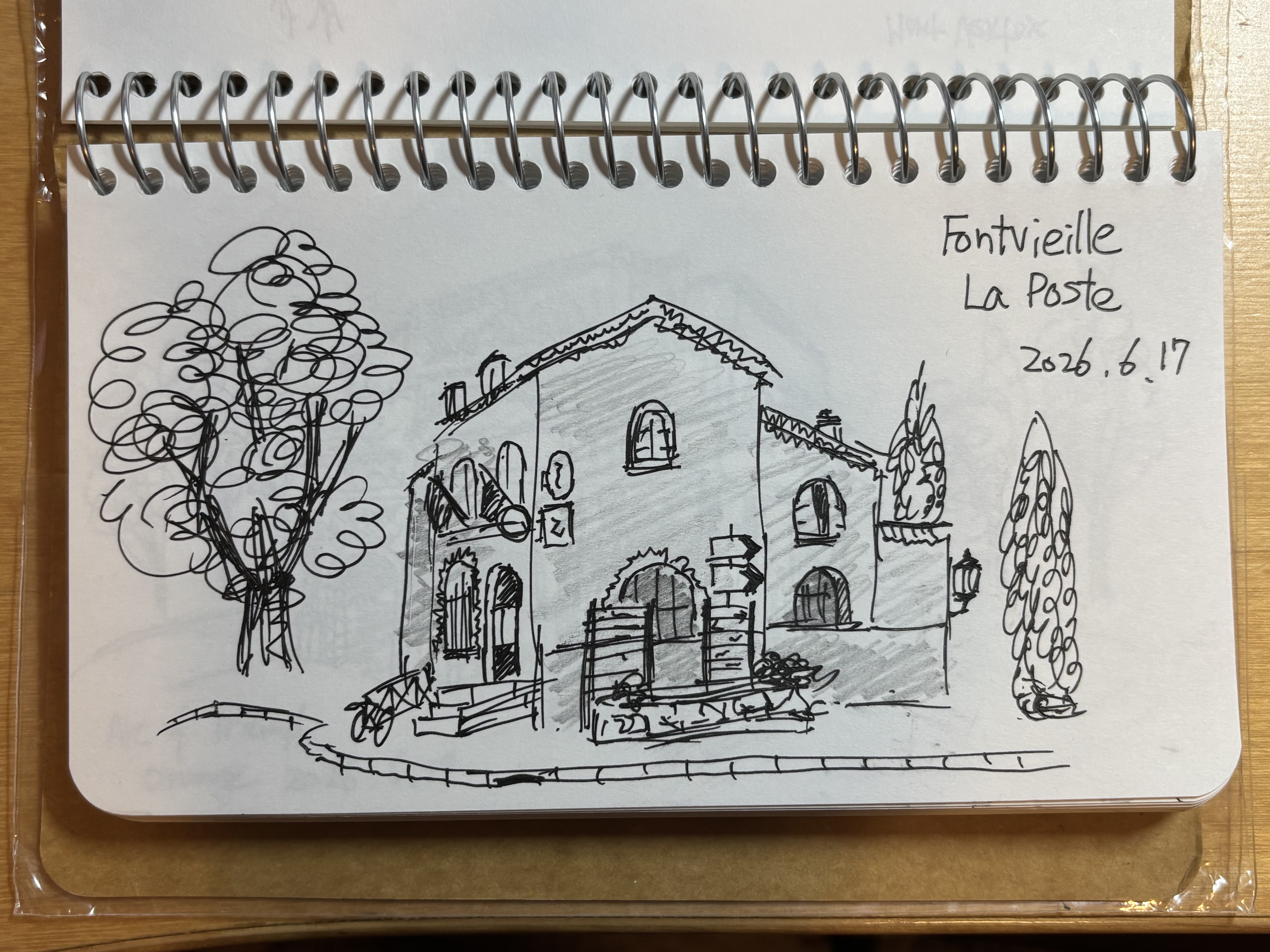
The charming little house across the street served as the post office. The beautiful colors of the French flag, the yellow of La Poste, the green of the trees, and the few people waiting for it to open. I still do not really know what drew me to sketch it. But from that chair, I knew with absolute clarity that the thing to draw was the post office. It is interesting, too, that the scenes I want to sketch are not always the scenes I want to photograph. What exactly is going on there?
I begin boldly with the large shapes, drawing quick lines. If I make a mistake, I do not worry about it. Oh, look, there is a lamp sprouting from that spot. I wonder what is behind that window. I observe these small details and add them in.
I learned a while ago that I do not need to draw realistically. With things like the branching of a tree, it is just right to scribble quickly and capture only the texture. If people move, that is fine. I can place that person from over there over here instead. I can leave out this tree because it gets in the way. Sketching lets me edit freely in ways a photograph never can.
I sink into this ordinary scene and let my hand move for a while without thinking. Maybe part of the pleasure is that I am not trying to think in words, logically or structurally. Time slows down, and I have the strange sensation of dissolving into the place itself. It only lasts about fifteen minutes. Every so often, so I do not forget, I take a bite of croissant and sip the coffee as it cools.
After drawing the lines in pen, I add light shading with pencil. It is fun to make the scene take on volume that way.
Really, it would be even more fun if I could add color.
In fact, I had brought a full set of watercolor supplies with me. Somewhere along the way, I had imagined sitting down to sketch properly. I would take a little picnic bottle of wine, sit in the shade of a tree, and paint the view in front of me. Sadly, I never found the occasion to use them. I was too restless, too eager to do this and that. At the time, I felt that spending time so luxuriously would be wasteful. Looking back now, I cannot help feeling that what was truly wasteful was not allowing myself to use time more slowly.
There are photographs that moved me deeply when I took them, yet look like nothing at all when I see only the image afterward. But if I use that one frame as a clue, the angle of the light, the air of that moment, and the time I spent standing still begin to return little by little. I still want to take some of those photographs and, slowly, turn them into watercolors. Perhaps while drinking a glass of French wine.