(If you have not read the prologue, start here)
In the second week of my bicycle journey through France, I had made my base for the week in Créon, outside Bordeaux. On the morning of June 10, I got up early. I meant to spend the day riding the Bordeaux Left Bank, the triangular peninsula held between the Atlantic and the Garonne River.
First I would load the bike into the car, drive to a station outside Bordeaux, and take the train north toward the tip of the peninsula. Then, with a tailwind behind me, I would ride about 100km back to the car through the famous wine villages of Saint-Estèphe, Pauillac, and Margaux. The night before, at least, it had seemed to me a magnificent and beautifully drawn plan.
But in the morning, heavy rain began hammering the windshield as I drove toward the station. There was no way I could ride in that. I could push the route to the next day. But I had woken up early and come all this way. The first part would be on the train anyway; maybe the rain would stop while I was heading north. I pulled into a gas station beside the highway, checked the forecast, and tried to think through ways to salvage the plan. The more I looked things up, the more my thoughts scattered in every direction, until I no longer knew what to do. While I was going in circles, the rain eased. In the end I decided to go to the station as planned, but now the train time was closing in. If I missed it, the next one would not come for three hours.
I parked, hurriedly assembled the bike, and went to the platform, only to find that the train I was supposed to take was the one train missing from the electronic board. There were patches of blue sky opening between the clouds, but no one at the station to ask. At last a woman appeared, and when I spoke to her she replied, in English, that she did not speak English. Still, she too was staring at the board, so I showed her a translated question on my phone and asked again. She turned her own screen toward me and told me the train had been canceled.
After more searching, I finally learned that it was a strike day for the French national railway. While I had been agonizing over whether the rain would stop and whether I would make the train, the foundation of the whole plan had already disappeared. But a rail strike did feel wonderfully French. I found myself feeling almost delighted.
I gave up on the train and decided to ride north from the station, then turn back when the time seemed right. The forecast still said the rain would stop after the morning. There was blue sky showing. The day, I thought, could still be rebuilt.
I had not ridden even 10km before the rain came again. I could not find a cafe for coffee, and the only shelter I managed to reach was a gas station behind a supermarket. Beyond the rain beating on the roof stood fuel pumps and wet pavement. I was supposed to be gliding elegantly through sacred wine country; instead I was stuck in a barren place where there was not a single thing I wanted to take a picture of. Regretting that I had not simply called the day off, I read a book on my Kindle and waited for the rain to weaken.
When it finally eased, I moved on and bought a croissant and coffee at a bakery. By the time I stepped outside, the sun had returned. My mood rose and fell with the sky as I made my way toward Margaux.
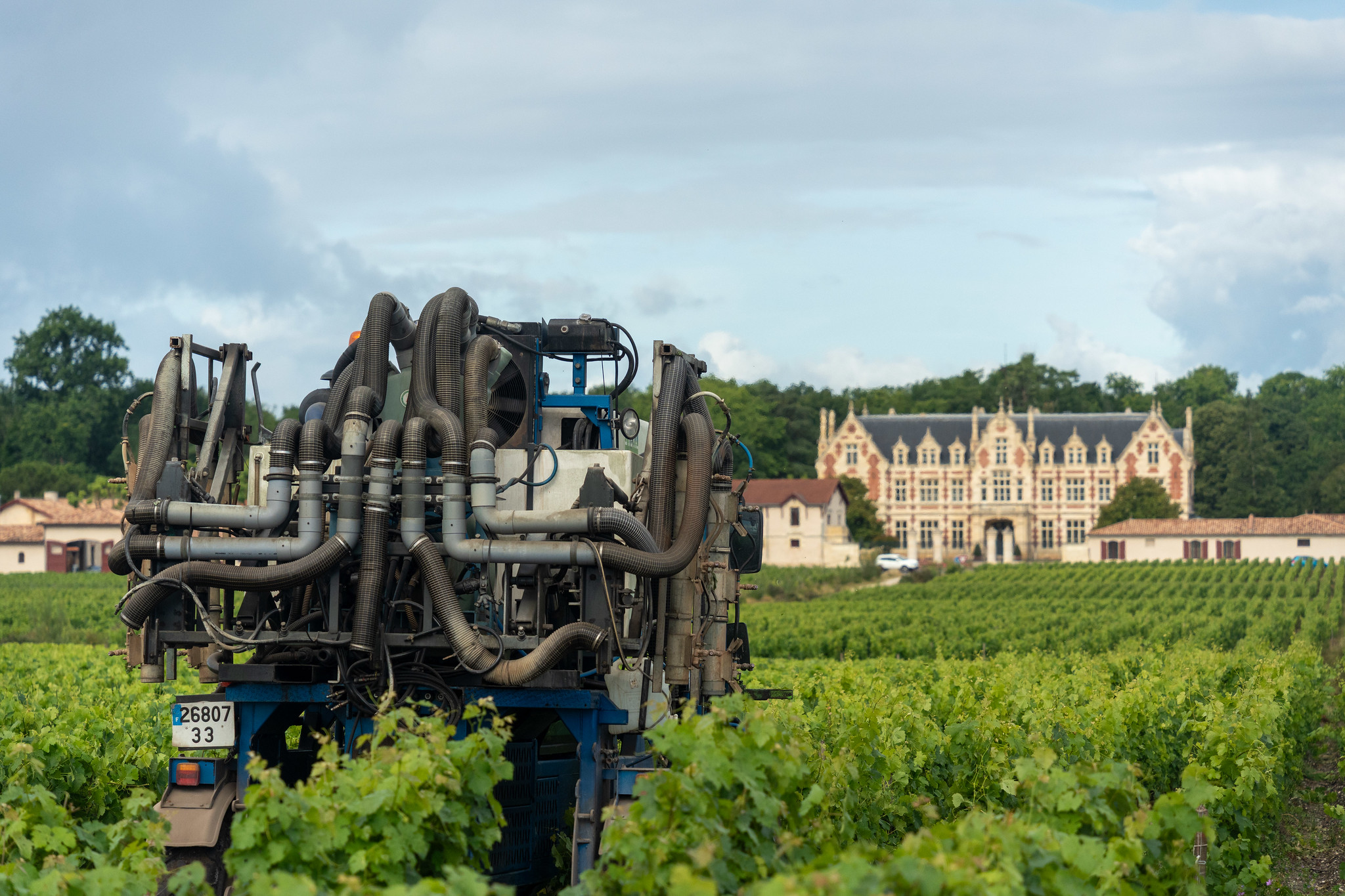
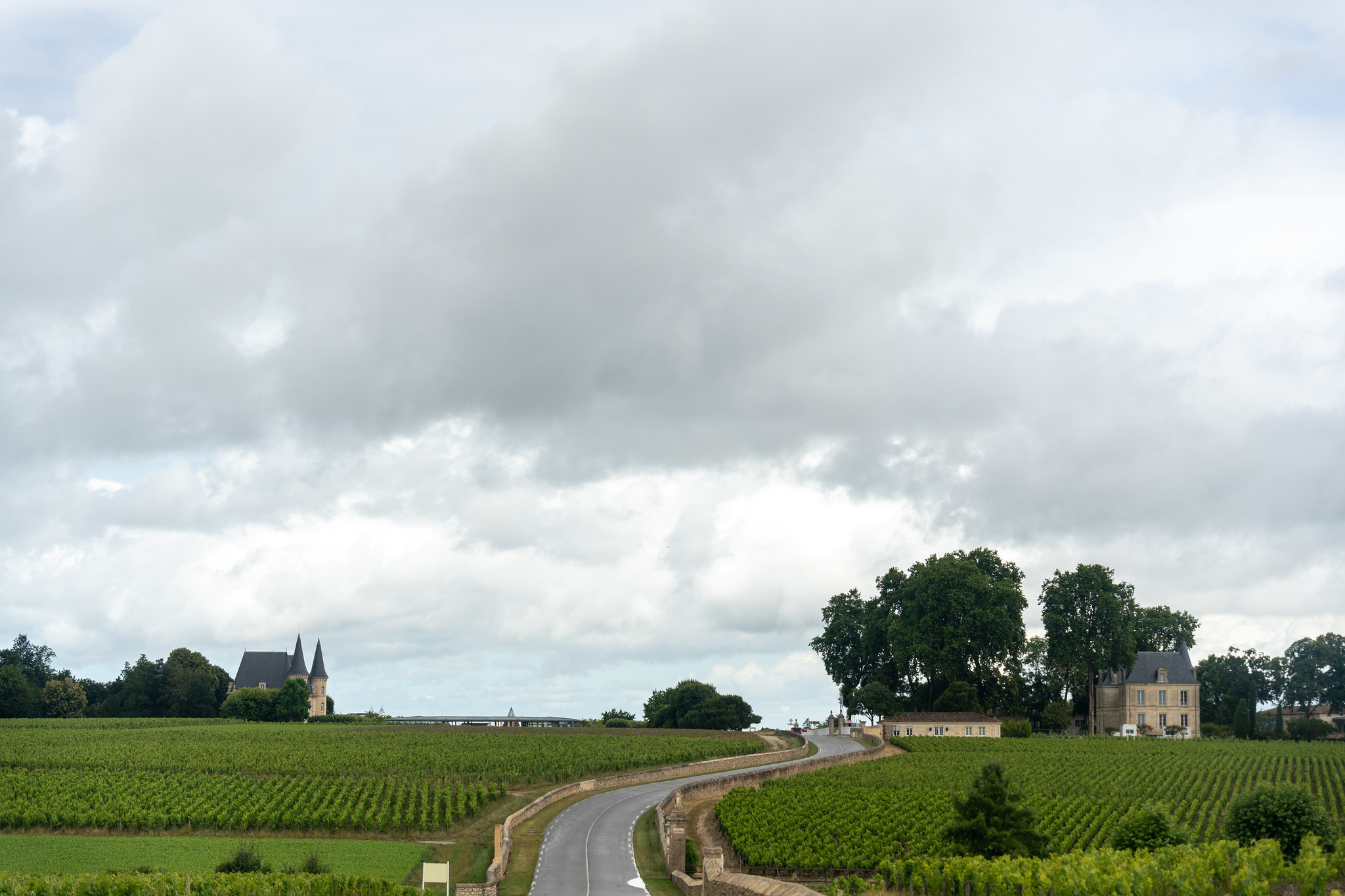
The vineyards that began spreading out on both sides of the road felt different from Saint-Émilion, on the Bordeaux Right Bank, which I had visited the day before. The enormous châteaux stood far back from the road, and that distance itself declared the scale of the fields. Huge tractors were at work everywhere. At the roots of the vines lay pale gray soil and countless round stones like the ones you find along a riverbank. Where the Right Bank had small producers lined up on hillsides, here the vineyards, buildings, and labor all worked at a much larger scale. The brightness of rain-washed gravel alternated with mansions that seemed to carry the wealth of the wine born from it.
Among them was an unusual building with red walls and a gray roof. Curious, I turned down the side road and found the gate marked Château Cantenac-Brown. It was the place that had made the Margaux wine Sacha bought for me in Amboise during the first week of the trip. The coincidence made me happy, so I signed up on the website for the 3 p.m. tour that day. It was so last-minute that I did not expect an answer, but I wanted at least to try.
I went on as far as Château Margaux, one of the five First Growth estates. It was not the kind of place where you could simply wander into a tour, but a kind person working there told me where to take a photo, and I continued on. Then, of course, the rain came again. This time I slipped into a restaurant that had just opened before the downpour became serious. I drank a glass of Margaux red wine and drew while I waited. Eventually, blue sky returned outside the window.
But before I had gone even another 10km, yes, unbelievably, the third rain arrived. Once again, the only roof I could borrow belonged to a gas station. Even when the rain lightened and I started riding again, it never fully stopped, so in the next town I went into a restaurant and called it lunch. Somewhere in me, I was still believing the forecast that said there would be no rain in the afternoon.
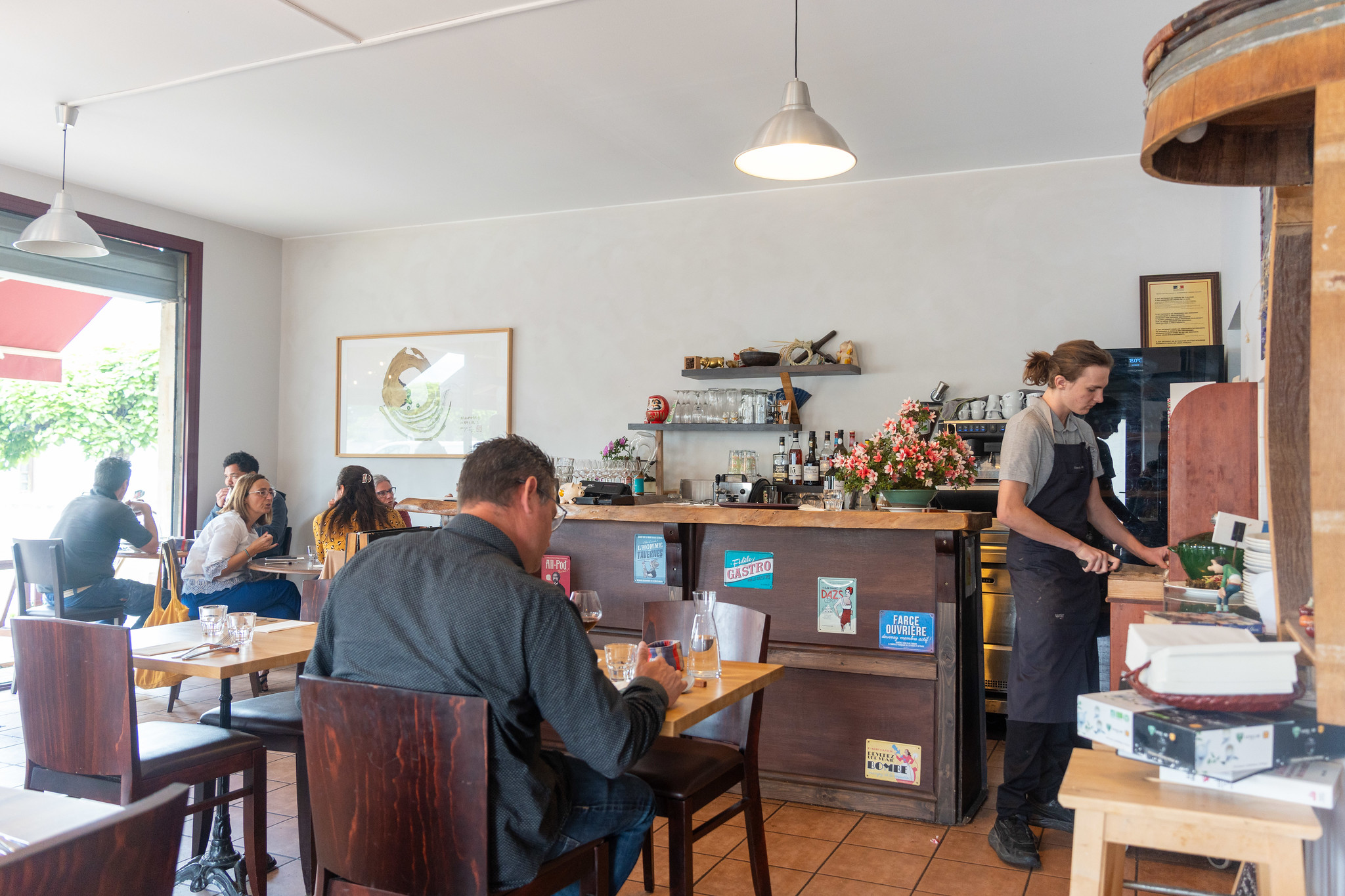
An experienced-looking Asian woman and a young man who still seemed to be learning the work were serving the restaurant. Since I could not hurry onward, the hours of the lunch service moved slowly in front of me. Looking around the room, I noticed a couple of Japanese fortune charms. Hmm. Then, on a piece of calligraphy hanging on the wall, small Japanese characters read, “In celebration of the 10th anniversary.”
When I spoke to her in Japanese, the woman was surprised. She had come from Japan to Bordeaux to study wine, she told me, and while working in restaurants she met a French chef and married him. They had opened this place fourteen years earlier. The calligraphy had been commissioned from a Japanese calligrapher living in Bordeaux. If it had not rained, I would never have eaten lunch in this small town, or noticed the Japanese on the wall. I could not pretend that a short conversation was enough to understand fourteen years of running a restaurant in a foreign country. Still, the Japanese we exchanged in the middle of a busy lunch, together with the charm and the calligraphy, gave me an emotional connection to this one shelter among all the places where I hid from the rain that day.
When I finished eating, sunlight was falling outside. I got back on the bike and turned north again. And before I had gone even 10km, yes, exactly as you suspect, rain again.
By then I had finally had enough and turned back. I still had no reply about the 3 p.m. tour, but I decided to return to Cantenac-Brown, the estate I had found that morning. On a weekday, perhaps they could make something work. I also held a small hope that if I explained how I had happened to drink their wine the week before and then happened to pass their vineyard today, they might let me in.
The man who met me at the entrance was named Guillaume, and he had a mustache. He had not yet seen the email. Unfortunately he had already begun another task and could not guide me that day. After being stopped again and again by rain, and after turning back at last, even the door I had reached would not open.
But when I told him that I had happened to drink this chateau’s wine the previous week, Guillaume was pleased, and told me to come back the next day at any time. Precisely because I could not enter then, a promise for the following morning remained.
By the time I returned to the car, I had ridden 90km that day. Before going home, I stopped at the bakery I had found the day before, the one that had won first prize in the Gironde baguette competition, and bought a baguette and appetizers. At the house, the two dogs were waiting. Even the one that had kept its distance the day before came over, and both of them entered my room. When I gave them the ends of the baguette, they were ecstatic. Rain and a strike had pushed me around all day, and I had not reached the places I had imagined. Even so, what remained were the calligraphy on the wall, the next morning’s appointment, and two dogs gathered at my feet.
The next morning I ate without rushing and returned to Cantenac-Brown at ten. Guillaume, the same man from the day before, was at reception. I was the only guest for that time slot. Because my walk-in request had been refused the previous day, I ended up with him as a one-on-one guide. His English was fluent, and once he began speaking his explanations flowed on so completely that it was hard to interrupt. But if I was the only guest, I did not have to hold back either. I steered him toward the things I wanted to say and ask.
Cantenac-Brown has 80 hectares of vineyards. At that scale, winemaking is not the work of a single maker. There is an owner, and someone responsible for the direction of the brand. There are people who decide the harvest and the blend, people who manage the vineyards, people who oversee the barrels and cellar, and seasonal workers who hand-pick the grapes. To me, it looked like a whole team made up of a coach, players, and staff.
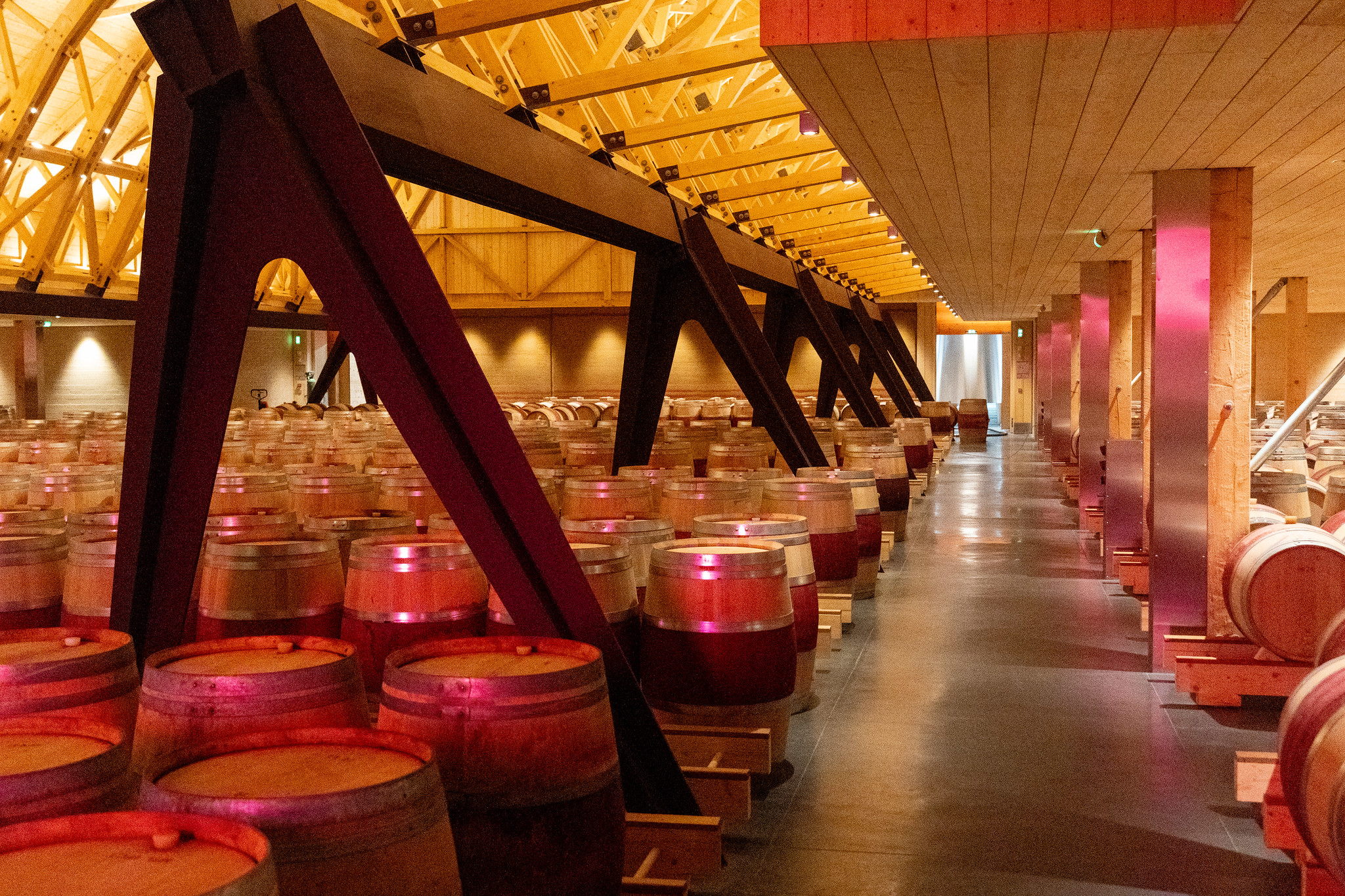
In the cellar, three workers were transferring wine from barrels into a tank. When they opened the bung of a barrel, red liquid rushed out. From time to time one of them caught some in a glass and held it up against a candle flame, checking something in the light. The weight of the liquid filling the enormous barrels, and the small flame flickering beside it. More than the grand house or the famous name, it was only when I watched those hands at work that I truly felt how wine-making is a human craft.
The winery, rebuilt as the vineyards expanded, was modern, but once inside it felt cool even without air conditioning. Thick earthen walls and the air circulation to the underground spaces held the temperature steady. The skylights were tinted pink, letting pale-colored light fall into the cellar. The smell of wine had soaked into the cold air. The space felt fantastical, almost removed from this world.
On the second floor was a black reception room, in contrast to the pink cellar. Guillaume pressed the back wall, and it opened like a door. Beyond it was a tasting room painted white, filled with light from a large window facing the vineyards. In that spare room, the green outside entered like a single framed landscape. Two days after I had been drawn down a side road by the red walls of the chateau, I found this bright room hidden even farther beyond the closed entrance.
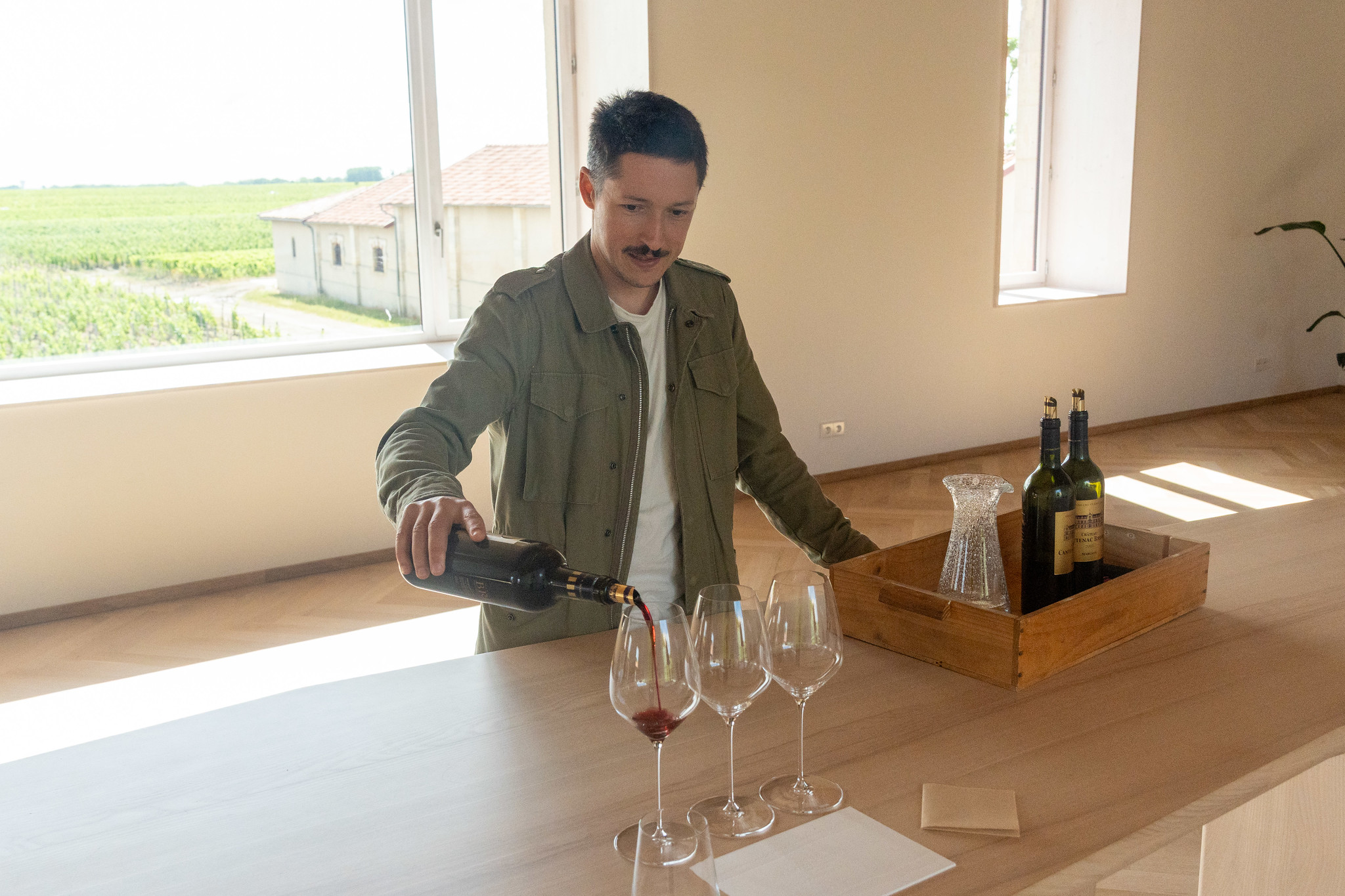
There Guillaume said that Bordeaux wine, in prizing history and status so highly, had raised its own threshold too far. He wanted it to be more approachable, not some difficult thing that had to be laid down for years before anyone could touch it. He was also worried about the recent decline in shipments. Because he worked on tours and social media communication, his words did not come from someone merely protecting tradition, but from someone trying to hand it to the next drinker.
At the same time, it was plainly true that high prices sustained the work of this place. Grapes with different flavors from each parcel go into separate tanks. Multiple varieties are grown. Fine adjustments in blending are tested. Wine is moved by gravity rather than pumps, and the temperature of the large cellar is carefully managed. All of that requires equipment and people. Measured as a practical, everyday product, this method goes far beyond rational efficiency, pouring resources into the smallest differences. To me it looked close to art, and that is to be celebrated. In the white tasting room, I could see both Guillaume’s wish to lower the threshold and make wine feel closer, and the fine craftsmanship that sustained that very prestige.
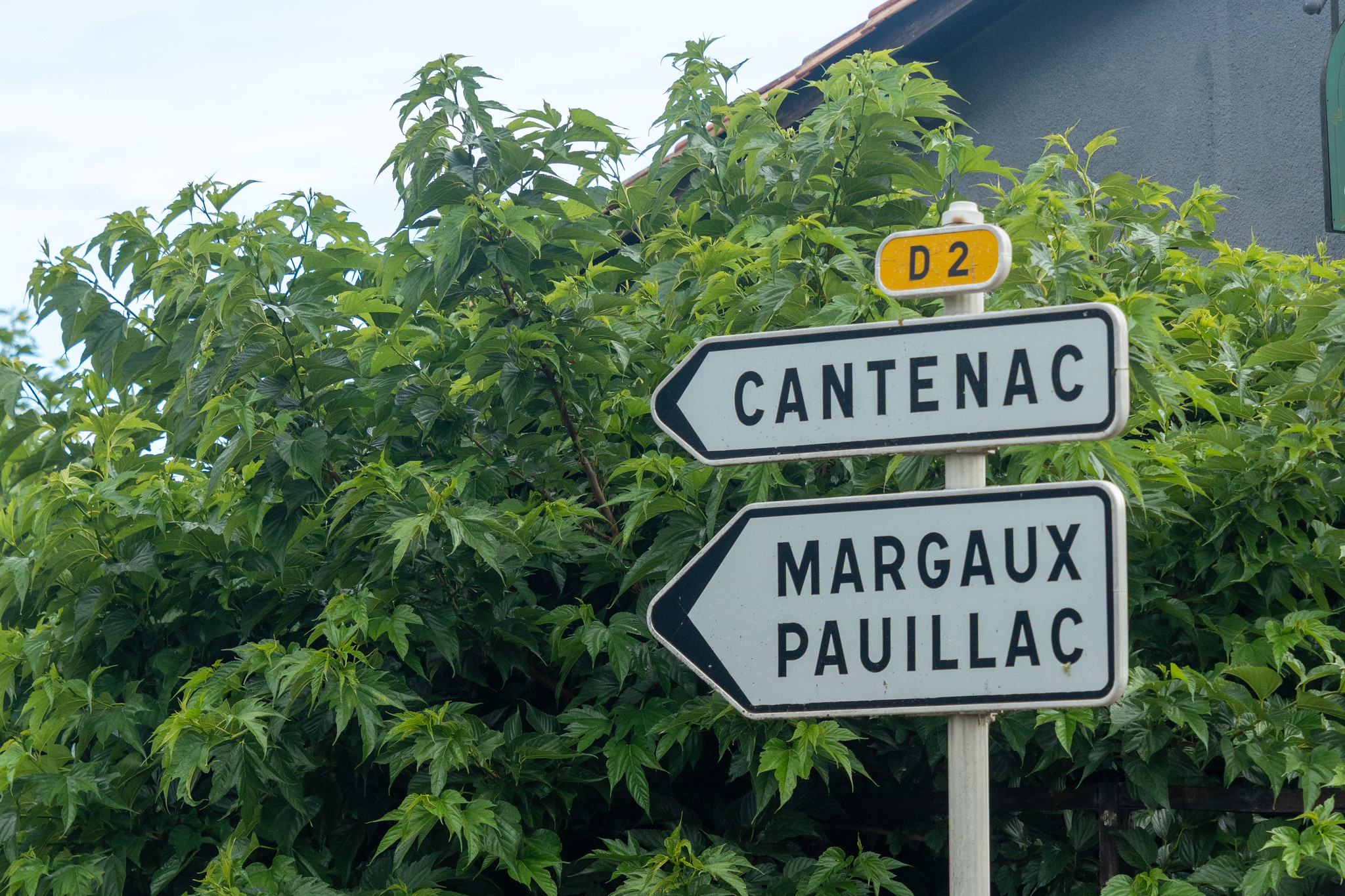
After the hour-and-a-half tour, I finally headed north by bicycle. The sky was utterly different from the day before, clear and blue. In a park in Margaux, local children were playing soccer. I passed beside them and rode the D2, the wine road. I also passed the restaurant where I had eaten lunch the previous day, but this time I decided to go a little farther.
When I sat down at a bistro in Saint-Julien, an Asian woman was eating alone at the next table. The dish that arrived in front of her looked delicious, so I asked what it was and ordered the same thing. When I said I was from Japan, she began speaking Japanese. For the second lunch in a row, a Japanese connection appeared.
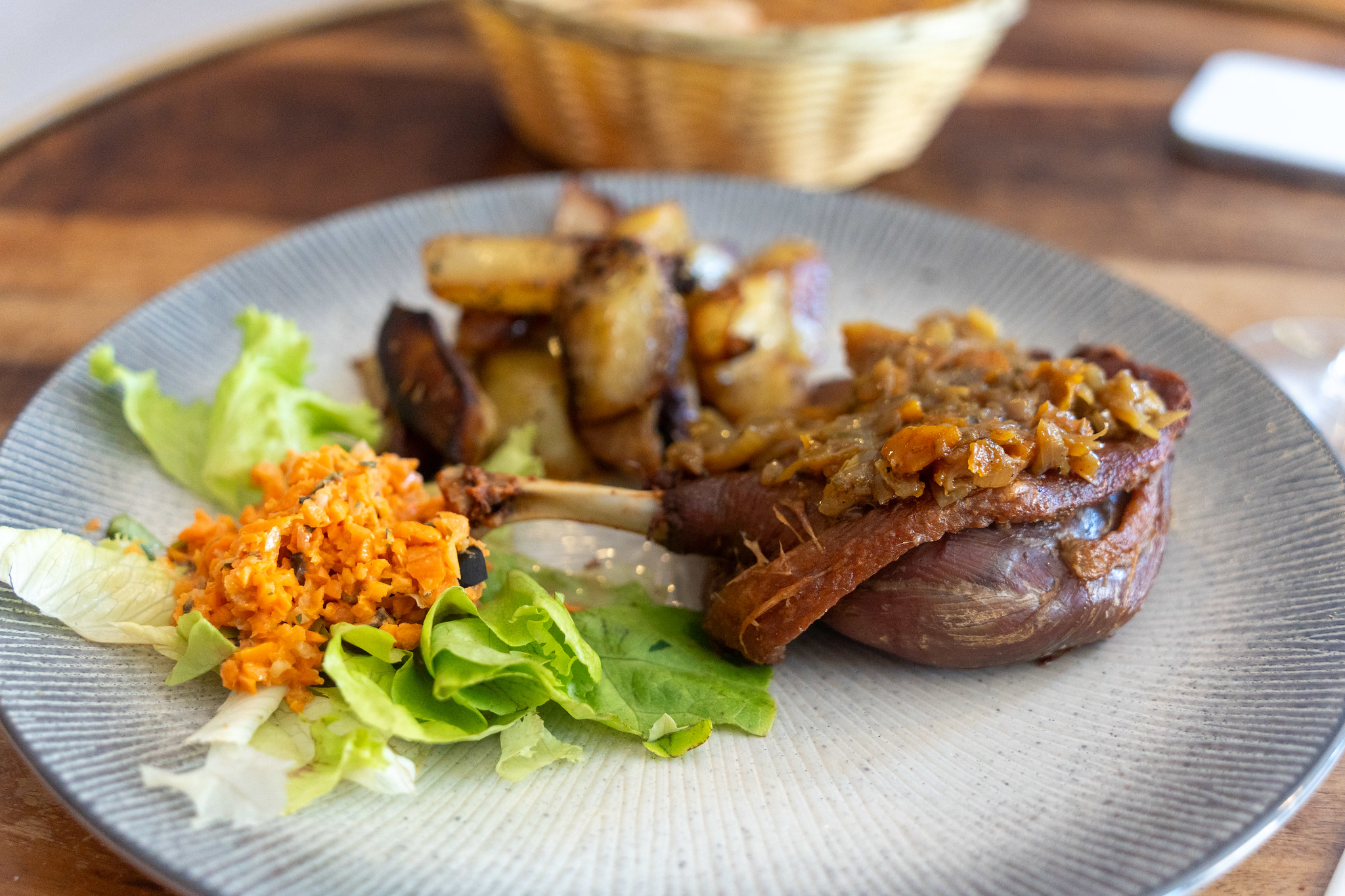
She lived in Bordeaux and worked as a guide and driver for people visiting wineries. As she said that, I quietly noted the glass wine in front of her. Anyway, she had come here when she got married, though she had not originally been a wine lover. Now, in this land, she worked with wine. She was in the middle of a day guiding clients, but she talked easily and asked me about all kinds of things. After we finished eating and said goodbye, I was getting my bike ready when the van she was driving passed in front of me, and she waved from the driver’s seat.
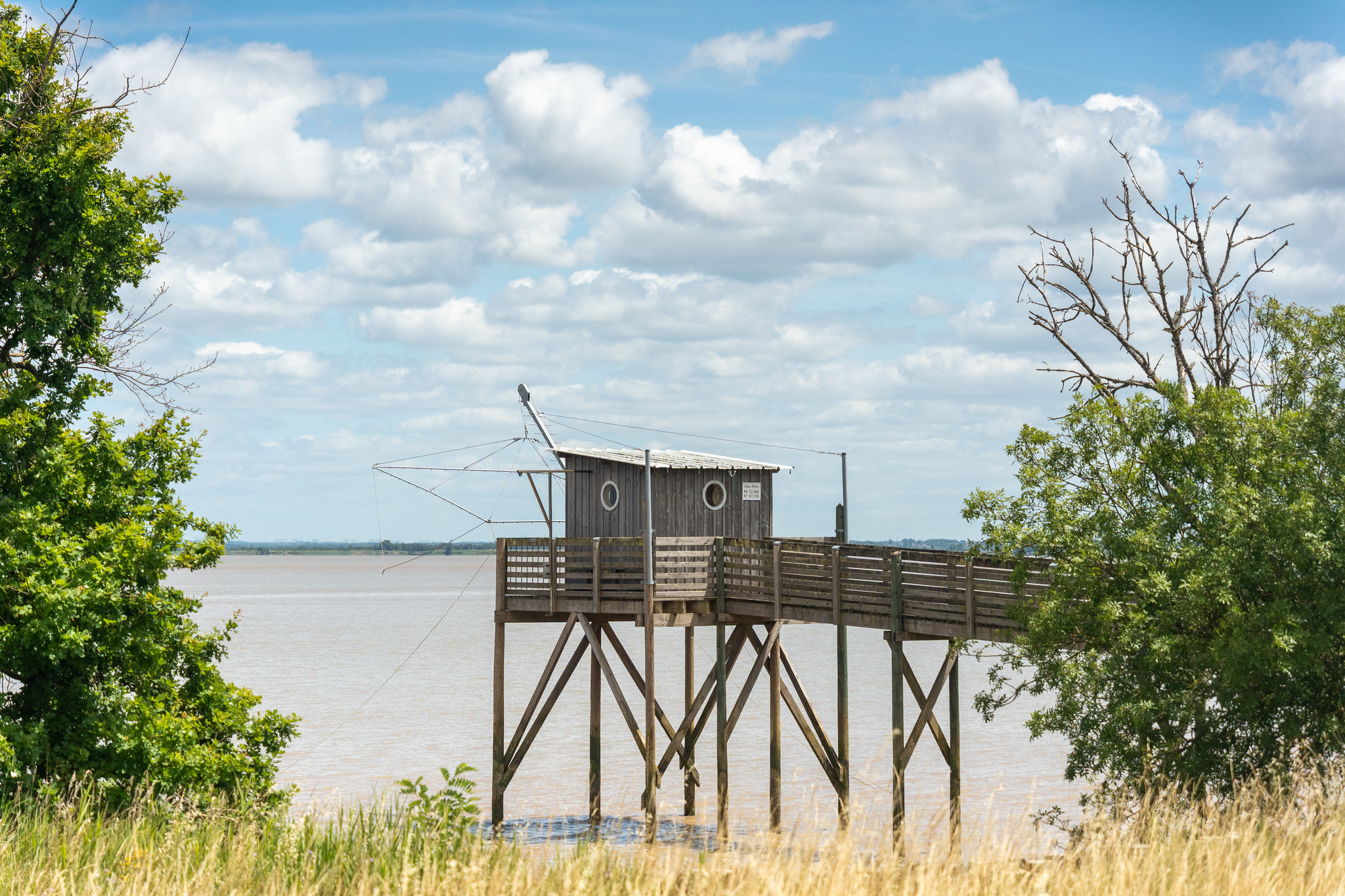
I rode through Pauillac and continued north along the road beside the river. Along the water, fishing-hut-like structures jutted out here and there, with cars parked near some of them. Saint-Estèphe was my turning point for the day. Though it is a famous wine village, there were few people in the center, and several shops were closed. The only person I saw was a heavyset man crouched over the ground, repairing something. Half of his backside was showing above his jeans. For some reason, I thought he was adorable.
Around the corner stood a beautiful church. I was struck by its stillness, so I stopped the bike, sat down on the cobblestones, and began to sketch. Cold seeped upward from beneath me. While I was riding, time had been driven forward by distance and speed; only while I drew lines did it slow down. A cat crossed in front of me, so I added it to the picture. What I could not find at the gas station the day before, something I wanted to draw, was there on the cold stones of an empty village.
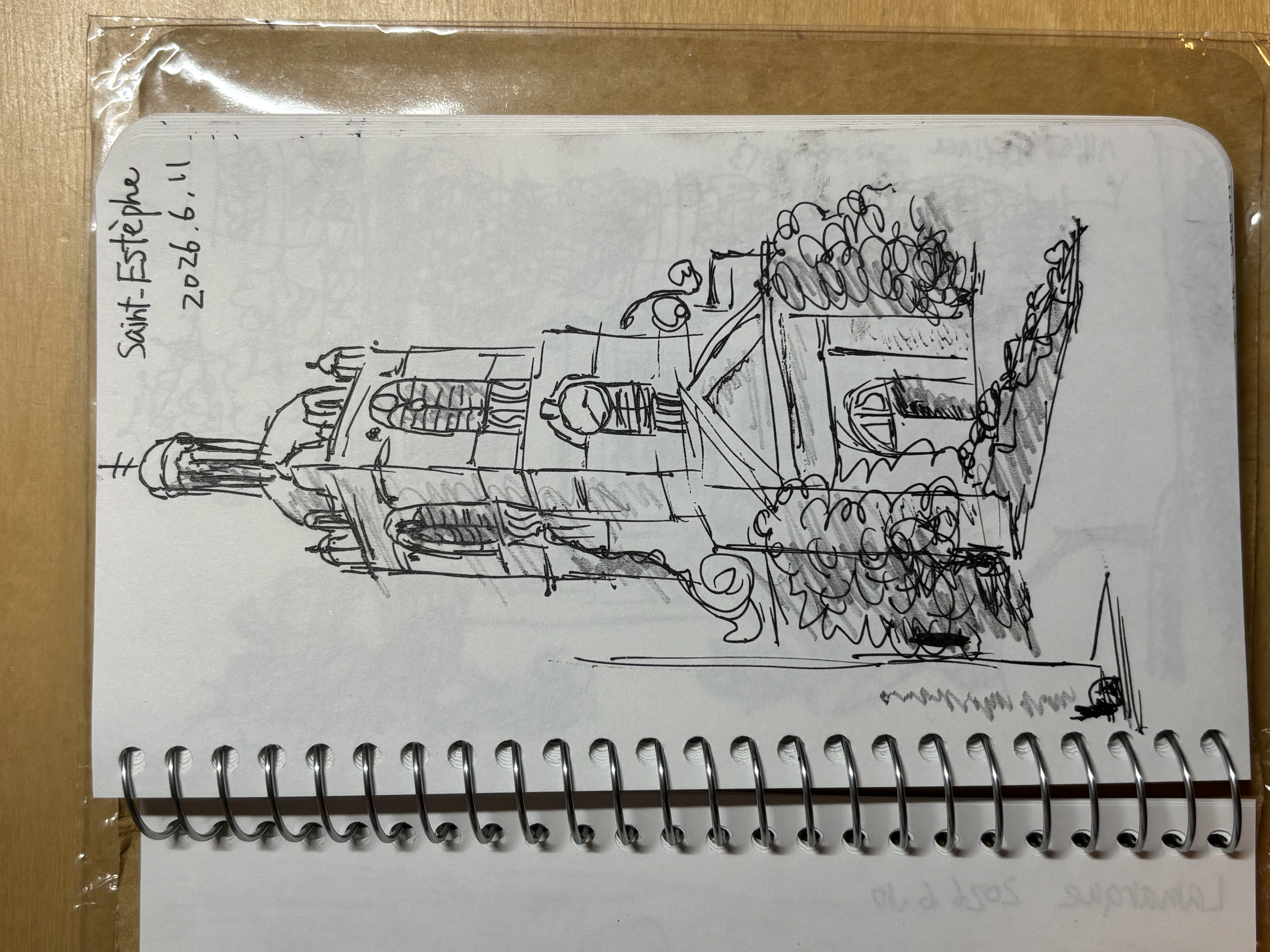
The way back was with a tailwind. Large châteaux appeared one after another on both sides of the wine road, with black limos and tour buses coming and going. I tried to rest in Pauillac, but passed through without finding anywhere I wanted to enter. More than the glamorous town, the quiet of Saint-Estèphe, where I had sat on the stones, remained in my body. I had ridden the road to Margaux several times by then, and at the end I used the tailwind and pressed hard on the pedals. When I pushed hard, my mind grew quiet, and only the gentle rises and falls of the road continued. I rode 70km that day.
After loading the bike into the car, I decided to buy a bottle of Saint-Estèphe wine. At a wine shop I said it would be my first time buying a Saint-Estèphe, and when the clerk asked my budget, he explained that some bottles improve with age, while others are already ready to drink. What Guillaume had talked about that morning came together here. From the bottles he showed me, I chose a 2018 second wine from Château Lafon-Rochet, the yellow estate that had caught my eye along the route. The label was yellow too. I had also stopped at that shop the previous day while searching for shelter from the rain, and the woman working there remembered me.
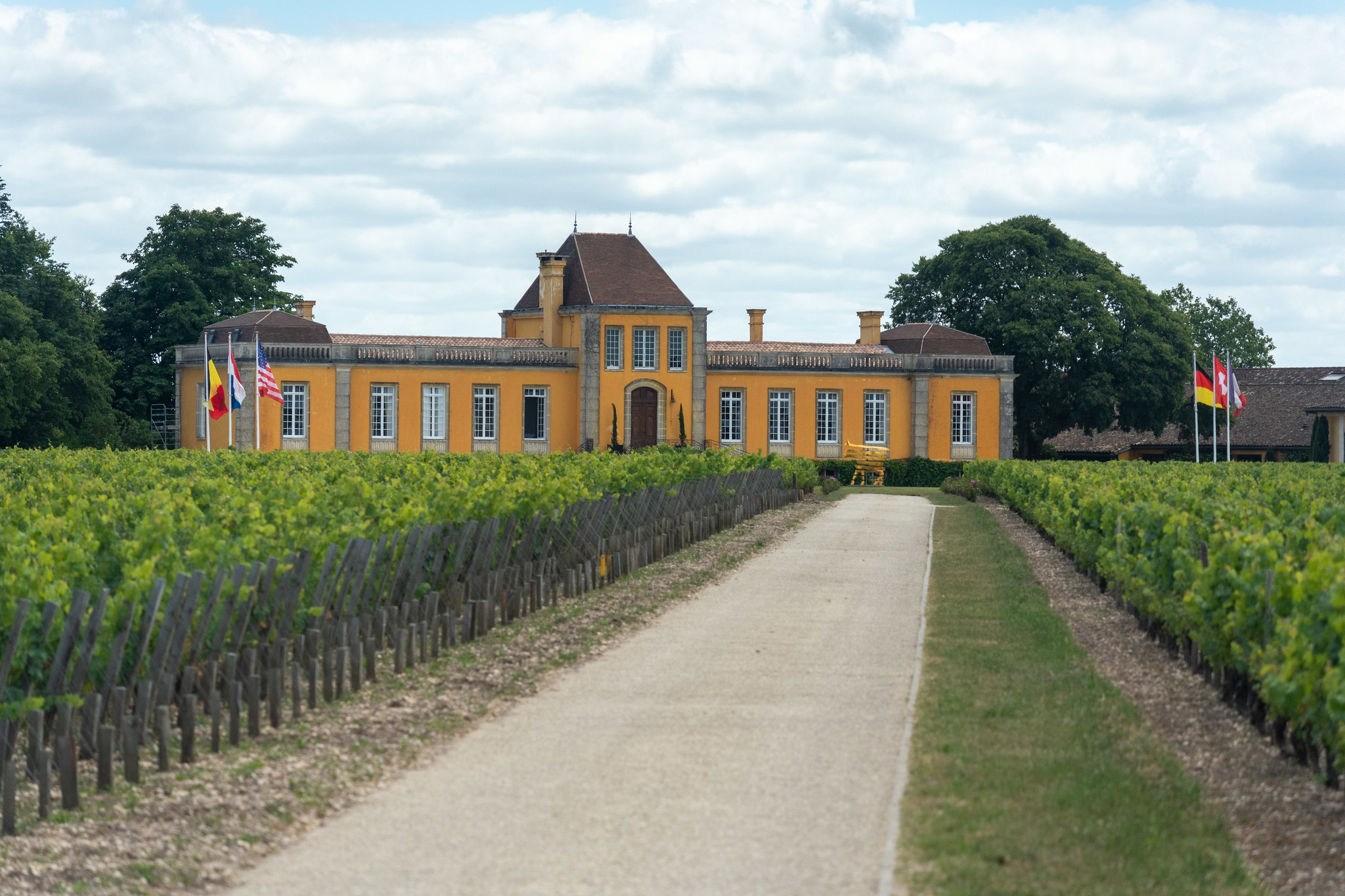
I bought a baguette and fruit, went back to the house, and cooked chicken in olive oil. Listening to the fat crackle, I opened the wine with the yellow label. At first the flavor and aroma felt tight, but after it rested for a while it opened into a wonderful wine.
If the train had not vanished, if I had not fled again and again into gas stations, if I had not finally been turned away at the entrance, I would not have had Guillaume to myself the next morning. But it was not that the rain had prepared anything for me. The rain simply fell, the train was simply canceled, and Guillaume had his work that day. My plan was stopped each time. Still, because I went back to the same door the next day and then rode north, what remained with me was wine held to candlelight, pink light, cold cobblestones, and one yellow bottle of wine. The chicken fat gave another small crackle.