(If you have not read the prologue, start here)
For the first of my four weeks in France, I chose Amboise, a small town on the Loire. It sits roughly in the middle of the country, about three hours from Paris by rental car.
Sacha, my retired former boss who lives in Switzerland, joined me there and spent a few days with me. Living with someone for the first time is a fresh sequence of adjustments, a quiet negotiation between two people’s habits. Breakfast, for example: he likes boiled eggs; I like fried eggs. Stand in the same kitchen and the small customs you normally never notice begin to appear. You align them one by one. As an adult, I do not get many chances to do that anymore.
We took our time getting ready and finally started riding around 9:30. The plan for the day was only about 50km, chosen with Sacha in mind, so there was no need to hurry. Almost as soon as we left the house, we stopped. Sacha had begun talking with a neighbor working in a field. Since I do not understand French, I became a little roadside statue, simply standing beside them.
The house where we were staying sat near the edge of Amboise, so in less than five minutes the houses thinned out and disappeared. Fields spread across rolling hills, with woods beyond them. In a vast pale-blue sky, small clouds floated as if someone had painted them for a children’s book. For no particular reason, my heart lifted.
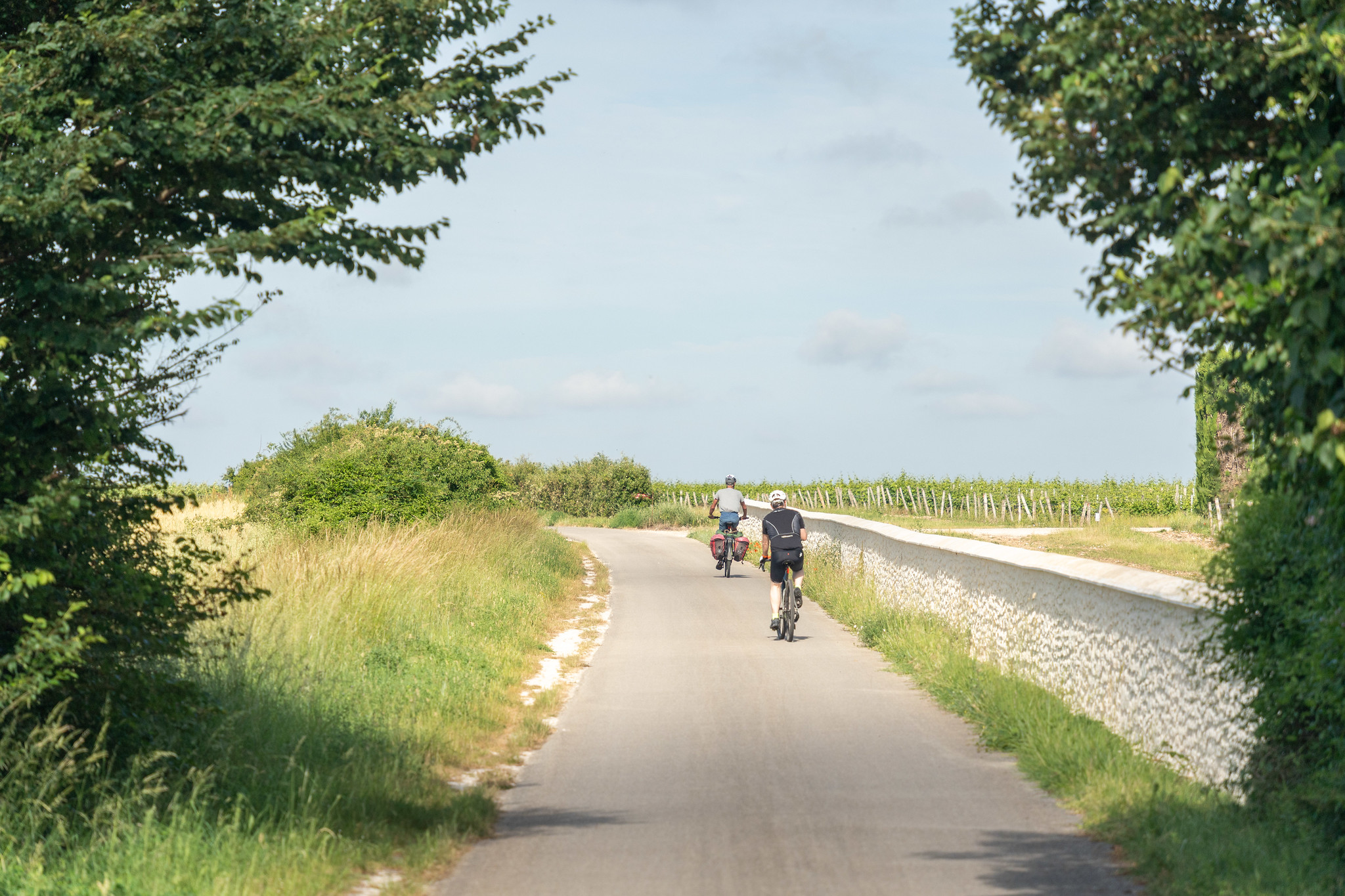
We passed through fields from one quiet town to the next. Ahead of us, a bicycle rolled along at an unhurried pace, a large load strapped behind the saddle. A bikepacker on an overnight journey. Since our own bikes were light, we would pass him, but whenever I stopped to take photographs, the same bicycle would glide ahead again. Passing and being passed.
The route we had chosen avoided the busier road along the river and threaded instead past people’s front doors. Toys left scattered in a yard let me imagine the life inside the house. If I had been alone, I would have stopped far more often to take pictures. But today I had someone with me, so I kept my stops in check. There was still a whole month ahead; there was no need to rush. And yet I also felt that the newness of this first day belonged only to this day.
When the road joined the cycling path along the Loire, the number of bicycles suddenly increased. Middle-aged riders carrying large loads like the man we had seen earlier came and went one after another, alone, in pairs, in groups. So this was French cycling culture.
Before long we entered Tours, the largest city in the area. At the entrance to the cathedral, small children were coloring printed pictures of the building on sheets of paper. It looked like a school field trip, a charming Monday scene. We parked our bikes, went inside, and when we came back out, a procession carrying a coffin emerged from the church entrance. Four men in matching suits bore it in a distinctive, perfectly synchronized way. Behind them walked a woman holding flowers. The coffin was placed in the back of a van, and a woman who seemed to be the chief mourner greeted the people who had come.
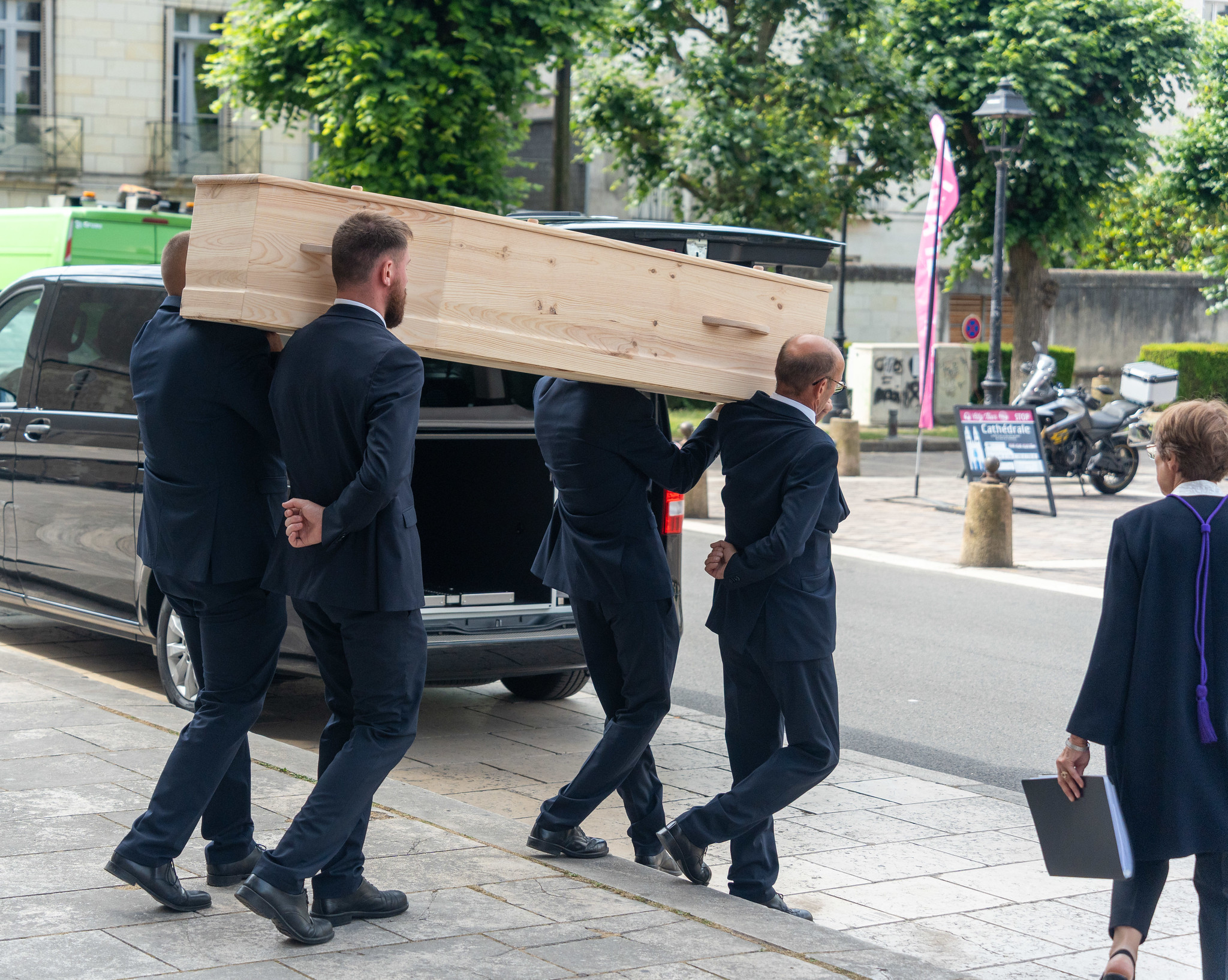
There is beauty in conduct that follows a ritual without hesitation. I have always thought of ceremony as one of humanity’s great inventions: by observing a shared form, anyone can express respect. In front of me, a traveler merely passing through an unfamiliar city, that city’s life and death, the ordinary and the extraordinary of daily existence, overlapped at the same stone doorway.
Around the halfway point of the ride, we sat at a table on a street corner and drank coffee. Order quickly, pay on the spot, finish drinking, leave. Such wonderfully European efficiency. Why can’t Americans do this?
The city had another large church drawing people in. The figure venerated there was a Roman general said to have cut his cloak in half and given part of it to a poor man; sure enough, the building had a relief of an ancient military figure wearing a cloak. Tours, I learned, is also one of the gateways for pilgrims walking the Camino de Santiago toward Spain. From beneath the wheels of my bicycle, from the road I was using simply to move from town to town, a long path stretched outward, one that people had walked for centuries. Just knowing that made the road before me look slightly different.
Leaving Tours, we rode for a while on roads with more cars, but eventually the route returned to the river. Beside a broad wheat field lay a fallow field covered end to end in red poppies. As we came into the next village, we found a restaurant with tables set out along the river and stopped for lunch. Its name was L’Auberge du Pont, literally something like The Bridge Inn. Cyclists sat at the tables lined up by the water. As I drank French beer and ate fish, Sacha and I noticed a man two tables away drinking his after-lunch coffee. It was the bikepacker we had been passing and being passed by all morning. He noticed us too, and from there the conversation began.
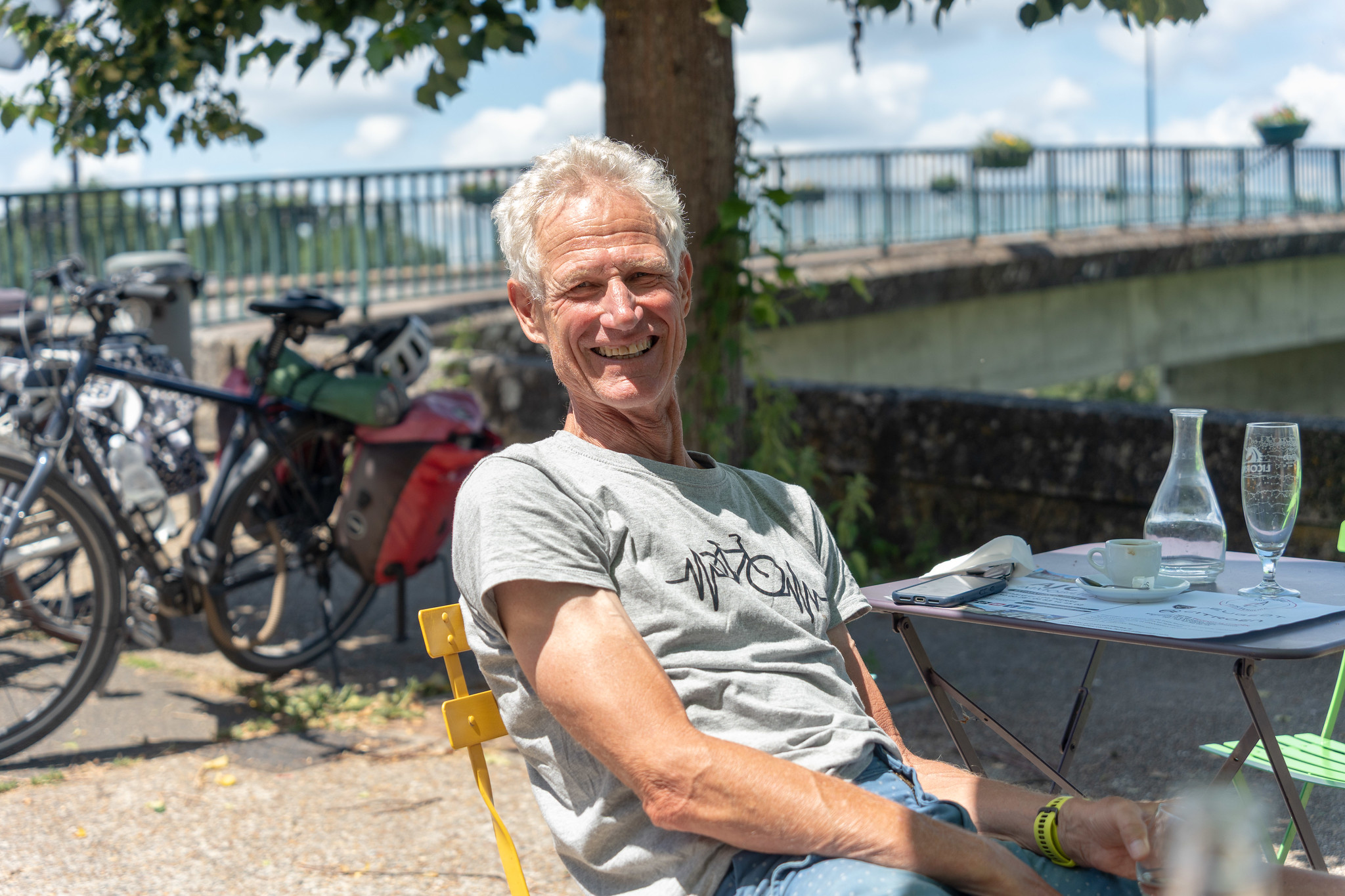
His name was Chris. His skin was burned bright red by the sun. He was a 69-year-old German, and he had ridden here from his home near the French border. That meant he had already covered at least 800km. From here he wanted to continue to the Atlantic, follow the coast south into Spain, and reach the Spanish pilgrimage destination we had just been talking about. But he had promised to meet his wife in Bordeaux at the end of June, so he might not make it that far.
The distance was not the only thing that astonished me. Chris had not decided his detailed route, or even where he would sleep that night. He had a sleeping bag, so sometimes he slept outside; sometimes he stayed in a hotel. If he decided too much in advance, he said, he would no longer be able to enjoy what he encountered on the road. He did not want that.
Ever since his first bicycle adventure to the next town at about age ten, Chris had been enthralled by riding far away. He had crossed Alpine passes from Switzerland into Italy. Once, during a journey, he saw a sign saying “Istanbul 200km” and decided that was close enough to make a detour. I envied those wings of the mind, loosened by travel until 200km could feel near. He remembered vividly both that first adventure nearly sixty years earlier and the journeys he had made across Europe since.
Not fixing the itinerary, moving in response to what appears in front of you: this was not mere whim. It was a way of leaving space for chance to enter. Through my own bicycle journeys in Japan, I had begun to learn that places outside the plan and unexpected encounters often become the memories that shine the brightest. With his heavy load and sun-reddened skin, Chris looked like someone who had practiced that kind of travel for decades.
After parting from Chris, we headed toward the beautiful old Château de Villandry. A white limestone castle stood there, surrounded by vast geometrically arranged gardens. Above the gardens was a pond, whose water must once have nourished all that ordered green. The place carried the atmosphere of the Renaissance, of an age when the French monarchy was immensely powerful. It conveyed, even now, the wealth of France at the end of the Middle Ages. As I imagined this, I heard the sound of horse hooves from behind the castle. For one instant, time slipped backward.
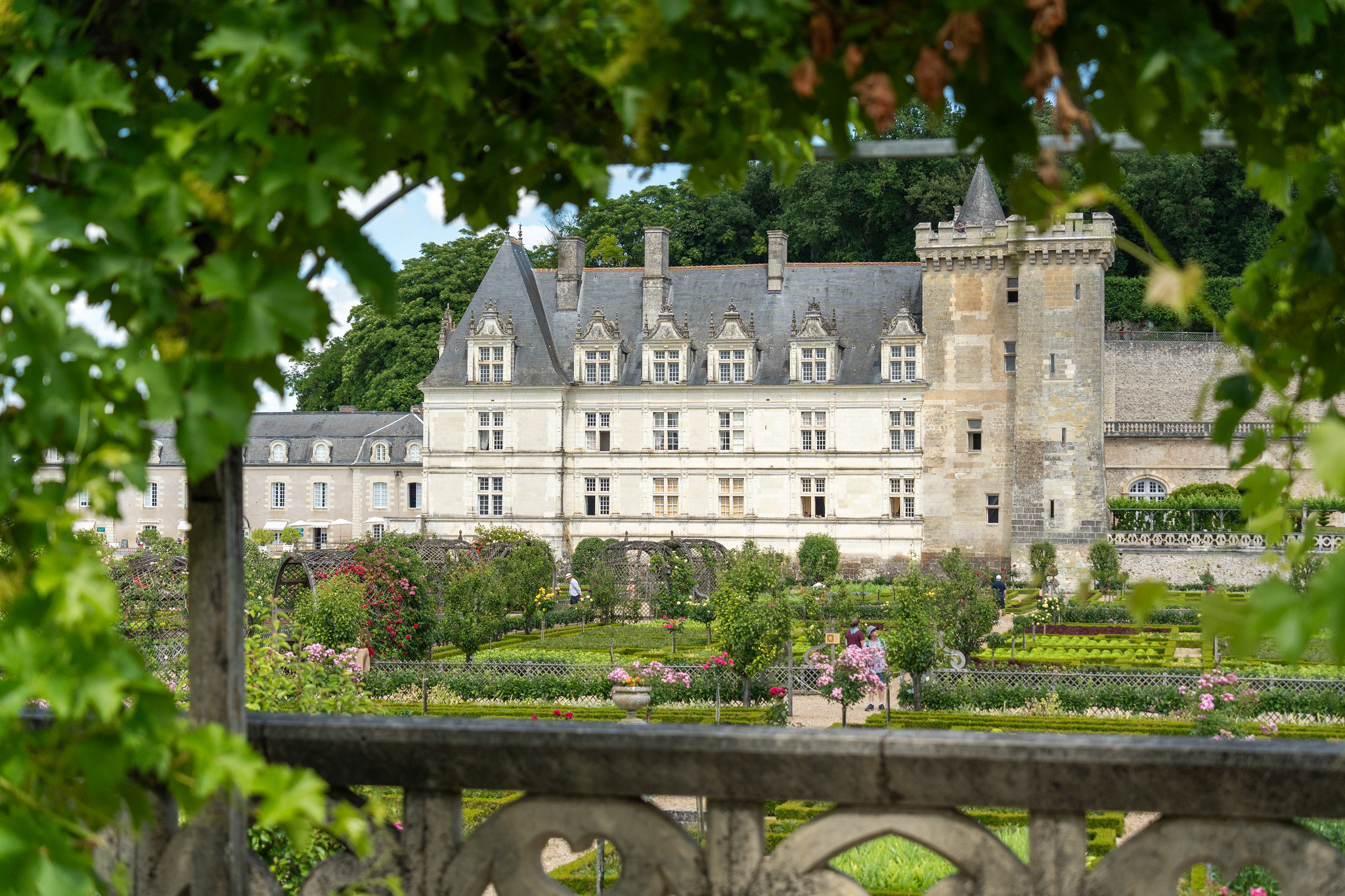
The green of the gardens, the benches set in the shade of trees, the pale-blue sky, the chalk-white castle: everything was stunningly beautiful. If I had brought a watercolor set, I felt, the entire day would have ended right there. I would not mind spending a day like that sometime.
Villandry was, nominally, the day’s destination. After looking around for a while, I checked the time and saw that it was already past three. If I intended to cook dinner, as planned, then we needed to start heading back. As we rode quiet roads toward the nearest train station, a white convertible passed us from behind. In the passenger seat sat a woman wearing a wide-brimmed white hat. The hat moved in the wind. The moment was gone before I could take a picture. French people are stylish. And this country seems to have a spell over it that keeps such things from feeling affected.
In the town of Langeais we visited one more old castle and ordered drinks at a cafe where no one seemed in any hurry. I was watching the time for our return train, but through the town flowed a calm in which there appeared to be no reason to hurry at all.
We reached the station just in time for the train, only to discover that the once-an-hour service was an astonishing 50 minutes late. It could have become a dead stretch of waiting, but on that platform we met another traveler: Stefan, a pharmacist from North Carolina. He said he was traveling through France for five weeks, so I suspected he might be retired. He loved history and had taken part in American Civil War reenactments back home: wearing the uniform, marching, camping, and finally recreating the battlefield itself. In France, too, he planned to visit battlefields around the country. As we talked, the 50 minutes vanished.
At last the train arrived, and we pushed our bicycles into the crowded car. Talking with Stefan, the time to Tours also flew past. We changed trains there and returned to Amboise at 6:30. The roughly 50km day that had seemed so comfortably spacious in the morning had used up even the time we meant to spend cooking dinner.
Hungry, we went into a restaurant and I asked again and again for more of the bread they brought out. We drank a sweet local white wine, ate dessert, and stepped back outside. The long summer day had finally begun to tilt toward evening, and several large hot-air balloons were floating in the sky. How beautiful this region must look from above.
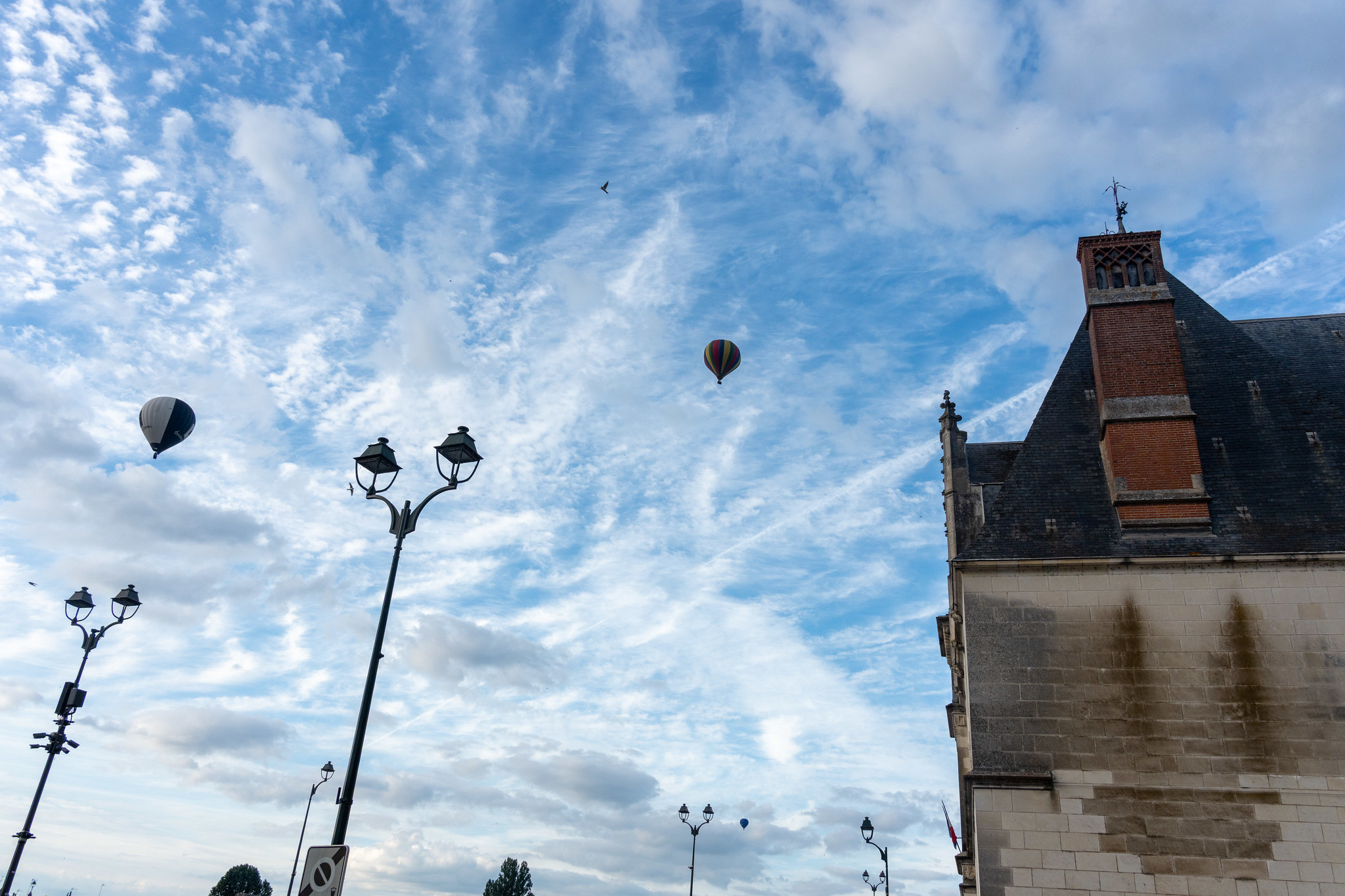
We had ridden only about 60km. Even so, we had seen children coloring and a funeral procession, learned about a pilgrimage road, visited medieval castles, met Chris and Stefan, and stood gazing at hot-air balloons floating in the immense sky. In the end I did not cook dinner, the train was late, and almost nothing went according to plan. But because we had left room for the unanticipated to enter, the day became far more meaningful than the one I had imagined that morning. Yes. This is what travel is all about.