(If you haven’t read the prologue yet, please start here)
When the spontaneity of solo travel combines with the mobility of a bicycle, you gain the absolute freedom of a bird.
My day started slowly after joining an early morning business meeting via phone. For breakfast, I was thoroughly tired of the standard fast-food beef bowl chains. A quick search pointed me toward a local noodle shop. It was the perfect opportunity to redeem myself after yesterday’s self-service Udon blunder. Perhaps because it was a quiet hour, a staff member who happened to be a fellow cyclist took notice of me and struck up a warm conversation. They sent me off with a cheerful, “Have a great ride!”
Leaving Marugame, I had to endure heavy traffic until I cleared the next industrial town, but past that bottleneck, the route transformed into a narrow road connecting quiet coastal villages. The scenery became stunningly beautiful. The road hugged the contours of the intricate bays, and the white guardrails stood out in vivid contrast against the deep blue sea and the lush green of the mountains. The flecks of rust on those guardrails silently spoke of the passage of time. In the distance, the grand, sweeping curves of the Great Seto Bridge spanned the horizon.

Parts of this coastal road had been recently repaved. When the asphalt is fresh, a road bike delivers a ride as smooth as velvet. I glided seamlessly through a dazzling world enveloped in azure and silver. A lone bird flew just above the water, keeping pace with me. Like that bird, I felt completely weightless. The bike granted me pure freedom. My summer vacation bliss had reached its absolute peak.
This region is dotted with countless small, ancient irrigation ponds. The terrain is surprisingly undulating, and the farmlands are modest in size. Farmhouses and these historic ponds are scattered among fields of wheat—this is the quintessential local landscape. It wouldn’t be until the following day, however, that I truly understood the profound engineering meaning behind this scenery.
In the middle of one of these quiet hamlets, a craft brewery suddenly materialized. One entire wall was covered in eccentric, bold artwork. It seemed almost wonderfully out of place in such a rural village, yet it radiated the brewer’s intense individuality and local pride, which made me smile. It stood on a hill overlooking the sea. On a proper summer holiday, the ideal move would be to spontaneously change plans and stop for a pint, but unfortunately, they weren’t open in the morning.

Every time the view opened up, the scenery was so breathtaking that I found myself laughing out loud. The hue of the water rivaled the tropical oceans—an ethereal mix of aquamarine and cobalt blue. It was so beautiful that I couldn’t help but call out to a roadside construction worker, “Is it even legal for a place to be this beautiful?” He smiled warmly and replied in the local dialect, “Aaahhh, the sea is perfectly calm today.” The stretch lasted for about 20 kilometers, but it felt over in a flash. That was how intensely elevated my spirits were.
Emerging from that dreamlike coast, I arrived in Takamatsu, which felt like a massive metropolis—the largest urban center on this southern island. The train station is designed with all the tracks terminating at a single concourse, a classic dead-end headhouse style commonly seen in European cities, proudly announcing itself as a true final destination. Right next to the station sit the ruins of a historic castle, around which charming, two-car local trains run on their tracks.
I wandered aimlessly through the city for a bit, passing through a covered shopping arcade that stretched for kilometers, before heading inland toward the east. This section proved to be the most grueling part of the day. A brutal headwind and the relentless sun drained my energy rapidly. No matter how hard I pedaled, it felt as though I was standing still.
Suddenly, an Udon shop appeared along the road. Noticing the packed parking lot, I decided to pull over for a lunch break. It would be my second noodle meal of the day, but my curiosity about the place won out. Customers were pouring into the shop in a ceaseless, roaring stream. I realized I was witnessing the heart of the local noodle culture. This wasn’t a tourist trap or a major highway stop; almost everyone here was a local. There were families, construction workers, and office staff who had come out together. I found myself quietly observing the faces of the local people, fascinated by their shared devotion to this single food.

Though my stomach was full, the heat remained unforgiving. The headwind showed no signs of letting up, and the road stretched out in a mind-numbing straight line. Mentally pushed to my limit and riding in a daze, I finally stumbled upon a cafe just before a mountain pass. Desperate for air conditioning, I stepped inside and felt as though I had stepped into a time capsule from the mid-20th century. Nostalgic pop songs played one after another, and manga magazines were piled high in every available corner. The faint scent of tobacco smoke, overgrown indoor plants, and worn-out sofas gave the place an incredible, retro charm. It was wonderful, and when I ordered a lemon squash cocktail, it came with a complimentary hard-boiled egg—a delightfully quirky, classy touch. Today, every spontaneous whim seemed to lead to a beautiful reward.
I crossed the mountain pass and entered the easternmost district of the province, an area famous for wasanbon, a rare, traditional fine-grained Japanese sugar. I stopped by a local confectionery shop to try some. The clerk there happened to be a big fan of a popular cycling anime, and immediately recognized the brand of my bike, Cannondale. She even gifted me a few extra traditional dry sugar candies as a gesture of hospitality. I was deeply grateful.
When I finally reunited with the Seto Inland Sea, its complexion had completely changed. It was no longer the brilliant aquamarine of the morning, but a deep, dark indigo reminiscent of the open ocean. I could feel the ancient cultural transition between the two historic provinces here—how the inner, sheltered sea gives way to the vast ocean. It is the same body of water, yet its character changes entirely. In this area, the islands vanished from view, leaving nothing but an empty horizon. I rode along the coastal highway. As the heat softened, my energy returned, though the headwind remained fierce. I didn’t rush or force it; I simply kept a steady, disciplined cadence. This, too, is a skill I’ve learned over time. Sports have a way of doing that—teaching you the proper architecture of the mind, a certain mental discipline.
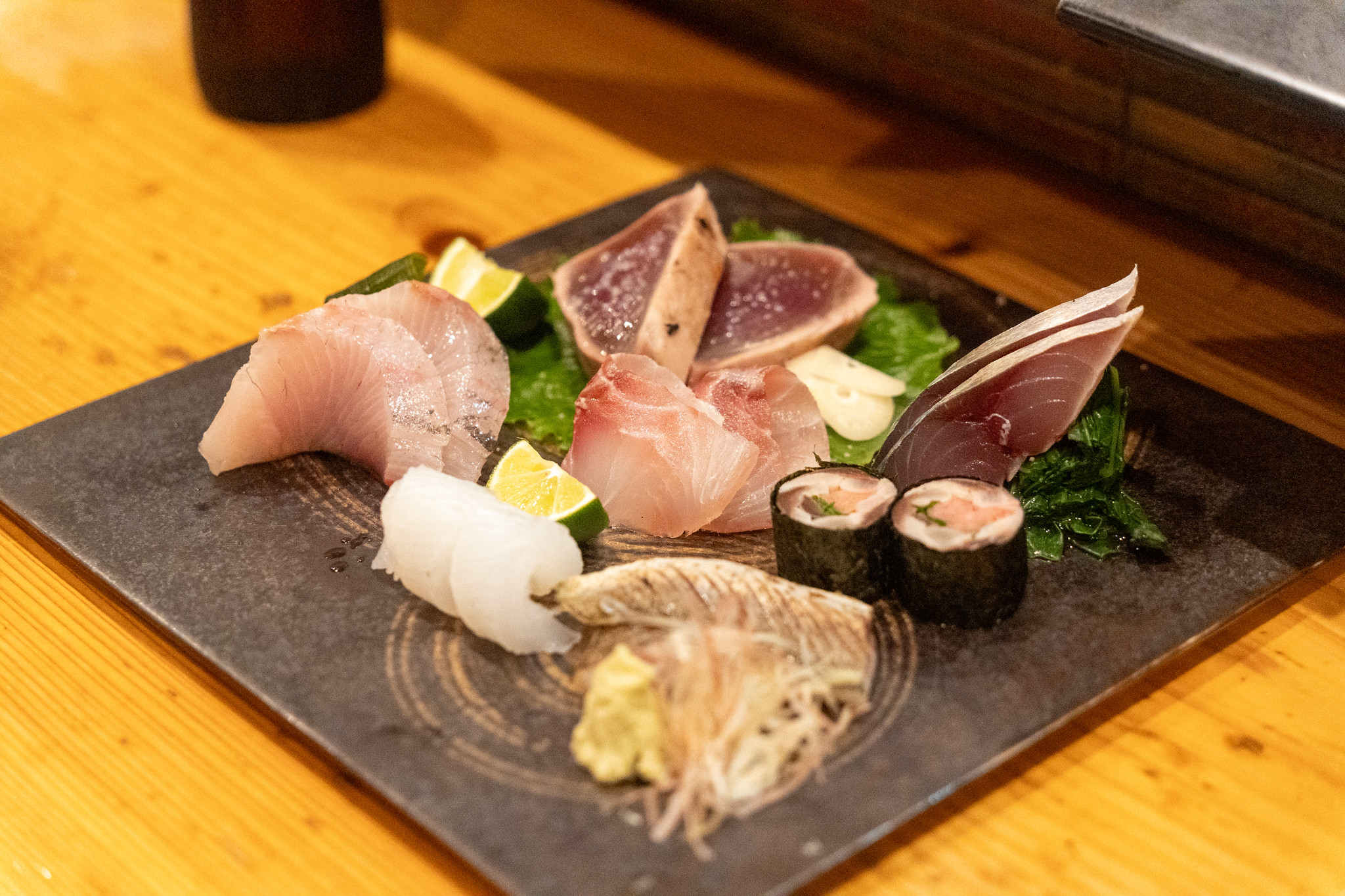
Entering the city of Naruto, my ride for the day came to an end. From there, I took a short bus ride to Tokushima to meet a childhood friend who now practices law there, and we shared a magnificent dinner. He was genuinely thrilled that a friend had traveled from so far away and took me to a stunning, hidden restaurant that only locals could ever find. The boy in my memory—the transfer student with a buzzed head who spoke in a sharp regional dialect—had, after 40 years, put on a lawyer’s badge and become a distinguished, deeply respected figure in his community. Everything he ordered for me was exquisite to my exhausted body. Sipping local sake, I happily devoured multiple bowls of white rice to replenish my calories. I shared the insights I had gathered on this journey so far, and we talked extensively about AI, a subject he is deeply fascinated by. Before we knew it, the restaurant had grown quiet and the other patrons had filtered out. When we stepped outside, the night had fully settled in.
To ride along the road, pulling over on a whim, and experiencing a fleeting intersection with the life of a complete stranger… and then, by nightfall, to arrive in a different province where the sea wears a different color, experiencing a profound reunion that transcends decades of time. Could there possibly be any greater freedom than this?