(If you haven’t read the prologue yet, please start here)
This trip begins in Hiroshima. Looking back, this day became a journey tracing the weight of war memories and the subsequent rebirth and sublimation journey.
At 5am at the bullet train station near my home in the Tokyo area, I waited for the gates to open. The first train leaves at 6am—surprisingly late, at least in the Japanese standard. Anticipating that riding there, and disassembling/packing my bike would take time, I had booked a later train, but I was ahead of schedule. Fortunately, I was able to change my ticket to the first departure. It was jarring to see a massive transit hub, usually teeming with crowds, completely deserted.
The first section of the train ride was a nostalgic journey, retracing the footsteps of my previous coastal route along the historic Tokyo ↔ Kyoto highway. The roads we took, the rivers we crossed, and the scenery we saw all flowed past the window. The weather was perfect today, and Mount Fuji, illuminated by the morning sun from a side, displayed beautifully crisp silhouettes.
As the train sped further away from my familiar routes, the window opened up to a flat plain where several major rivers concentrate into a small area. Ever since a previous cycling trip to the northern region had sparked my fascination with rivers and the history of flood control, landscapes like this filled me with excitement. I became completely absorbed in conversing with an AI about the geography. Flood disasters rarely cross the mind of someone living in modern times, but if left alone, rivers naturally accumulate sand and shift their courses. Flood control transforms plains into fertile land suitable for agriculture, and rivers are crucial geographical elements for defense and distribution—indispensable when thinking about the medieval period.
Heading even further west, past the second-biggest city in Japan, the sense of being in unfamiliar territory grew stronger for a Tokyo-based resident like me. Now I’m really journeying into unknown lands. Seeing a massive suspension bridge spanning the strait outside the window, I engaged in another lively conversation with the AI about its structural and engineering highlights. In understanding machinery, I believe the first approximation is grasping it as a hard and rigid structure, and the second approximation is understanding where its flexibility and “play” lie. Bridges possess the same quality. Accessing the ingenuity of such a design means accessing the pride of the people who built it.

With all this, the train ride to Hiroshima passed in the blink of an eye. Shouldering my bulky bike, I walked through the crowded concourse, assembled it outside, and glided forward. At first, like a warm-up exercise, I rode slowly, checking my body’s feel.
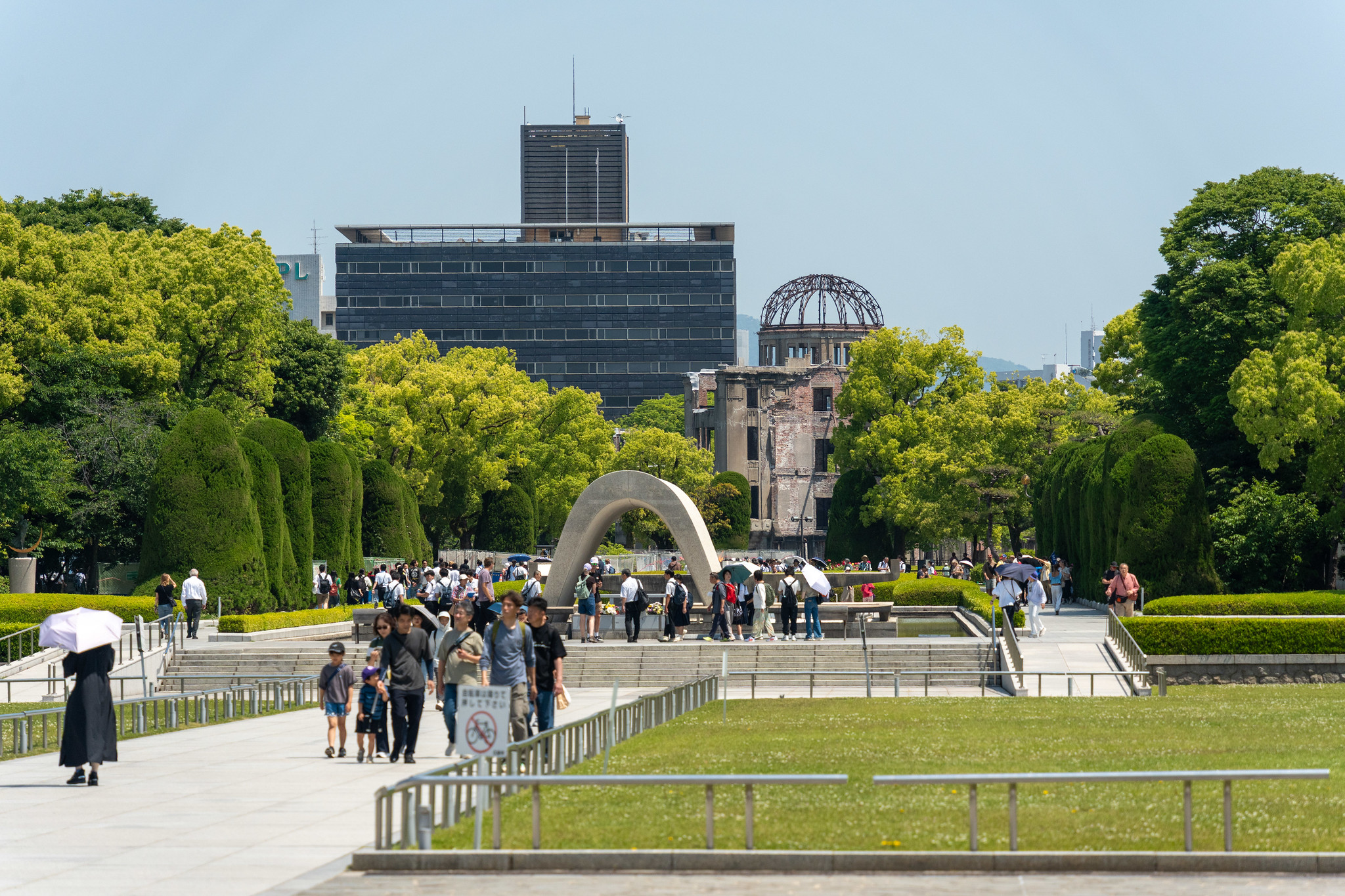
After a quick loop around the city’s historic castle, I made my way toward the symbol of the atomic bomb—the iconic ruined dome and the peace memorial park. Memories of my previous visit to the museum here came rushing back. Thinking about the unfathomable, overwhelming violence unleashed the moment the atomic bomb detonated, and the countless lives taken or left with immense suffering, my chest tightened with emotion. It also reminded me of the tsunami memorial park from my previous trip to the northeast. For a while, I closed my eyes, brought my hands together in prayer, and let my heart be gripped by the weight of it all. This is truly a place you cannot visit without shedding tears. Yet, as I let the emotion overwhelm me, the peacefulness of the world and the sounds of people’s cheerful conversations reached my ears, bringing tranquility to my heart. Yes, around me, it was a peaceful Saturday. Countless students on school trips and overseas tourists visited, listening solemnly to the guides’ explanations. Hiroshima’s prayer is reaching many people. I feel there is some form of salvation in that.
Leaving Hiroshima, I headed toward Kure. I passed by the colossal facilities of a major industrial steel plant. I heard that this former military factory, which once manufactured the main guns for the battleship Yamato, is now leveraging that same technology to produce nuclear reactor pressure vessels. In a city that suffered the horrors of the atomic bomb, the spirit of saying, “Let us use our technology to harness nuclear energy for peaceful purposes,” is incredibly admirable. It is strongly reminiscent of a brilliant counter-throw in judo.
The congested roads eventually began to clear, and finally, the route started running along the coast. The pervasive scent of the tide—so this is the Seto Inland Sea! The road and the single-track railway crawled along, winding through the narrow space between the mountains and the sea. Just across the water, islands came into view, with others overlapping behind them. Small sandy beaches. Ships, ships, and more ships quietly passing to and fro. Leaving the national highway as it was swallowed into a tunnel, I took a slight detour to stay along the coast. Away from the main road, I discovered a lovely cafe attached to a motorcycle repair shop and found myself drawn in. After all, a journey is about what you run into along the way, not the destination.

In the city of Kure, I stopped by the maritime museum dedicated to naval history. A large model of the battleship Yamato stood there, and the place was bustling with weekend crowds. Having been fully immersed in such things during my boyhood—even building a 1/700 scale plastic model of the Yamato back then—I don’t dislike it. However, what struck my heart more than the battleship itself was the fact that its wartime shipbuilding technology still lives on today in the construction of some of the world’s largest commercial container ships.
Speaking of battleships, it was customary in Japan to name naval vessels after ancient provinces or regional mountains and rivers. Several cruisers were named after the very rivers I had cycled along during my northern trip. The desire to protect the people is an unchanging sentiment that we in the modern era can deeply understand. A ship is not merely a lump of iron. It carries a mission and the wishes of the people who sent it off. Crystallizing those sentiments by giving them the names of the motherly rivers felt profoundly natural to me, having cycled through Japan.
Opposite the imperial navy museum is a present-day naval defense force museum, which catches the eye by proudly displaying an actual, full-sized submarine out in the open high above the ground. Although I was a bit mindful of the remaining ride I still have to take on today, I figured opportunities to come this far are rare, so I took the time to look inside. The exhibits covered the active role of minesweepers during international conflicts, the history of the coast guard, and the evolution of submarines. Just as there is a shadow in the old military exhibits of the imperial naval history museum, these modern defense exhibits hold a different kind of shadow. The people standing near the displays felt like military personnel, though I couldn’t tell if they were active or retired. I wanted to express a word of respect, but not knowing how best to do so, I simply walked past—a lingering regret. This town is such a remarkable place where one can study the history of the old and new navies all at once across a single street.
Leaving the air-conditioned museum, I remounted my bike. The saddle was baked by the midday sun, but I pedaled onward. Past the tourist spots, the road continued, overlooking the massive shipyards. This must be the shipyard that built Yamato 80 years ago. It now belonged to a modern shipbuilding consortium, that sounded entirely foreign. One of the docks was building a naval ship. Looking at that, one couldn’t help but sense the DNA continuing from 80 years ago; at the same time, they were also building container ships and fishing boats. Alas, if only I could see the software—not just the factory that my eyes could see, but the continuous human activity in this place—but there was no way for an outsider to access it. A pity.
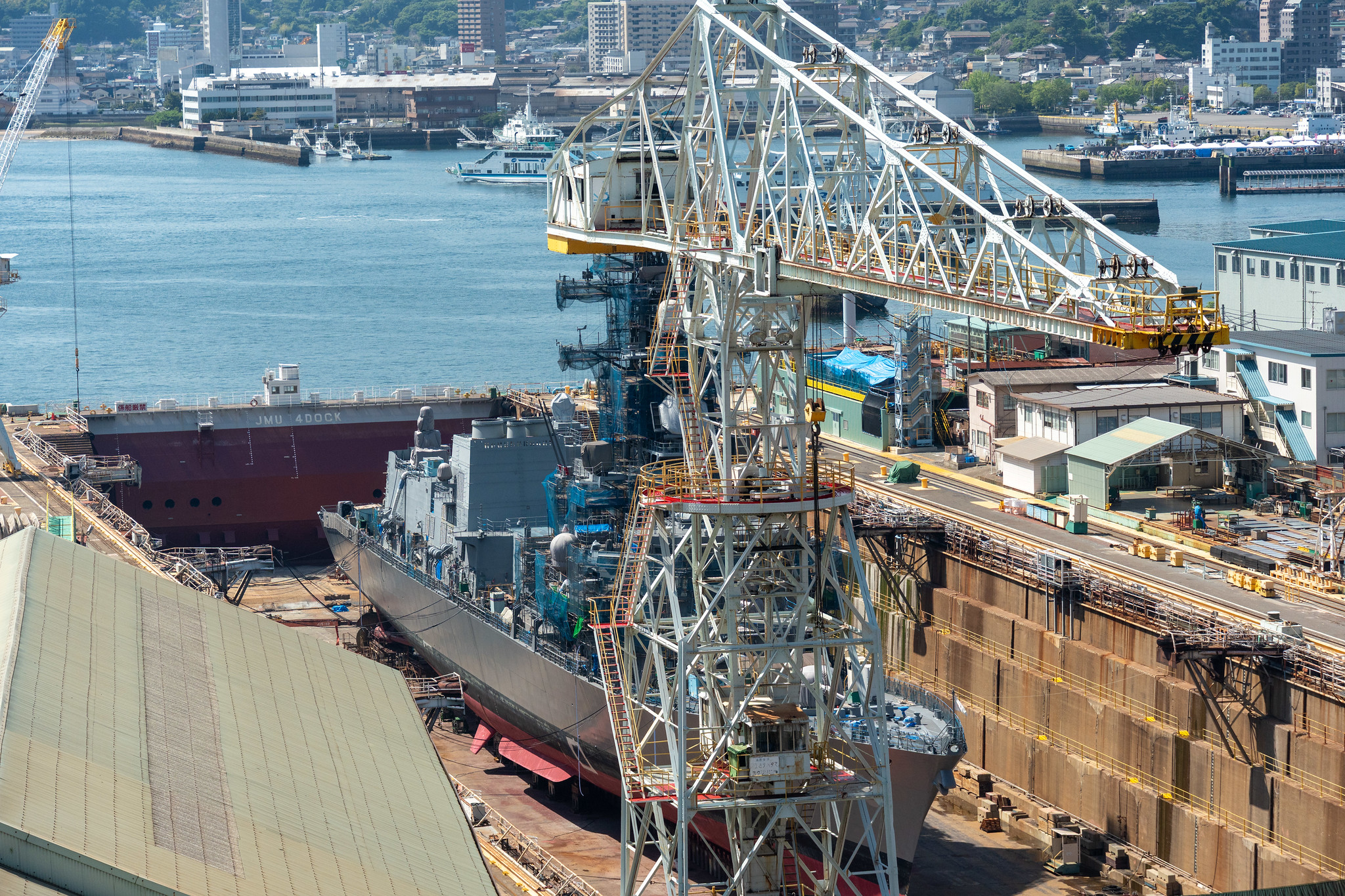
Leaving the city behind, human presence grew sparse. In its place, giant cranes emerged standing here and there in the intricate inlets. Shipyards. Even though it was Saturday, I could see operators inside the cranes maneuvering them from high above. Just climbing up there looks like an ordeal. What do they do if they need to use the restroom? Maybe they even eat lunch up there. What kind of view must it be from up top? Riding beneath the cranes felt like looking up at the surface from the bottom of the sea. Here, the ocean connects the factories, so a massive plant abruptly appears just around the corner of a peaceful countryside road. A scene quintessentially Setouchi.
A journey progressing like a string of beads from one fishing village to the next. Leaving one villege, climbing a slight hill, and sliding down into the next fishing village. The thrill when a downhill road curves and the view suddenly opens up. This is the epitome of the joy of cycling. Power surges into my pedaling legs.
It reminded me of riding through the rural villages of my previous northern trip. Here, the sea is pinched between islands, and people are pinched between mountains and the sea; everything feels cramped. There is no room here to create the vast rice paddies I saw in the north. They must hardly be able to harvest any rice. Those fertile, sprawling agricultural plains must have been an object of envy for the people here. However, that handicap led to the development of commerce and industry here, be it salt making or shipbuilding. What is disadvantageous and what is advantageous truly depends entirely on your perspective.
Since numerous oyster rafts were placed in the sea, I wanted to eat some oysters and stopped by a shop flying banners. It was run by a woman who came from coastal China, but business was slow, and remarkably, today was their very last day! My stopping by just 30 minutes before closing could only be described as fate. While chatting, I ate what was likely the shop’s final fried oyster. Was it just my imagination that I felt the emotions of the maker closing up shop today in the heat of that fried oyster?
Today’s destination, Takehara, is said to be a town famous for salt. The wealth gained from that salt was, in turn, poured into sake production. The old streets from the Edo period still remain, evoking the affluence of that era. At a shop in this district, I ate the region’s signature savory pancakes, drank local sake accompanied by local grilled oysters, captured photos of the dusk, and headed to the inn.

Once the sun went down, I was surprised by how completely devoid of human presence the town became, falling into utter silence. Where did the people who were in the shops just a moment ago vanish to? Didn’t Spirited Away begin exactly like this?
In the dark streets, lightbulbs began to dot the night, creating a silence that let one imagine the days gone by… Praying at a temple on a small hill, I peacefully watched this long day, which began with pressed hands in a city of prayers, disappear beyond the mountains.